Introduction
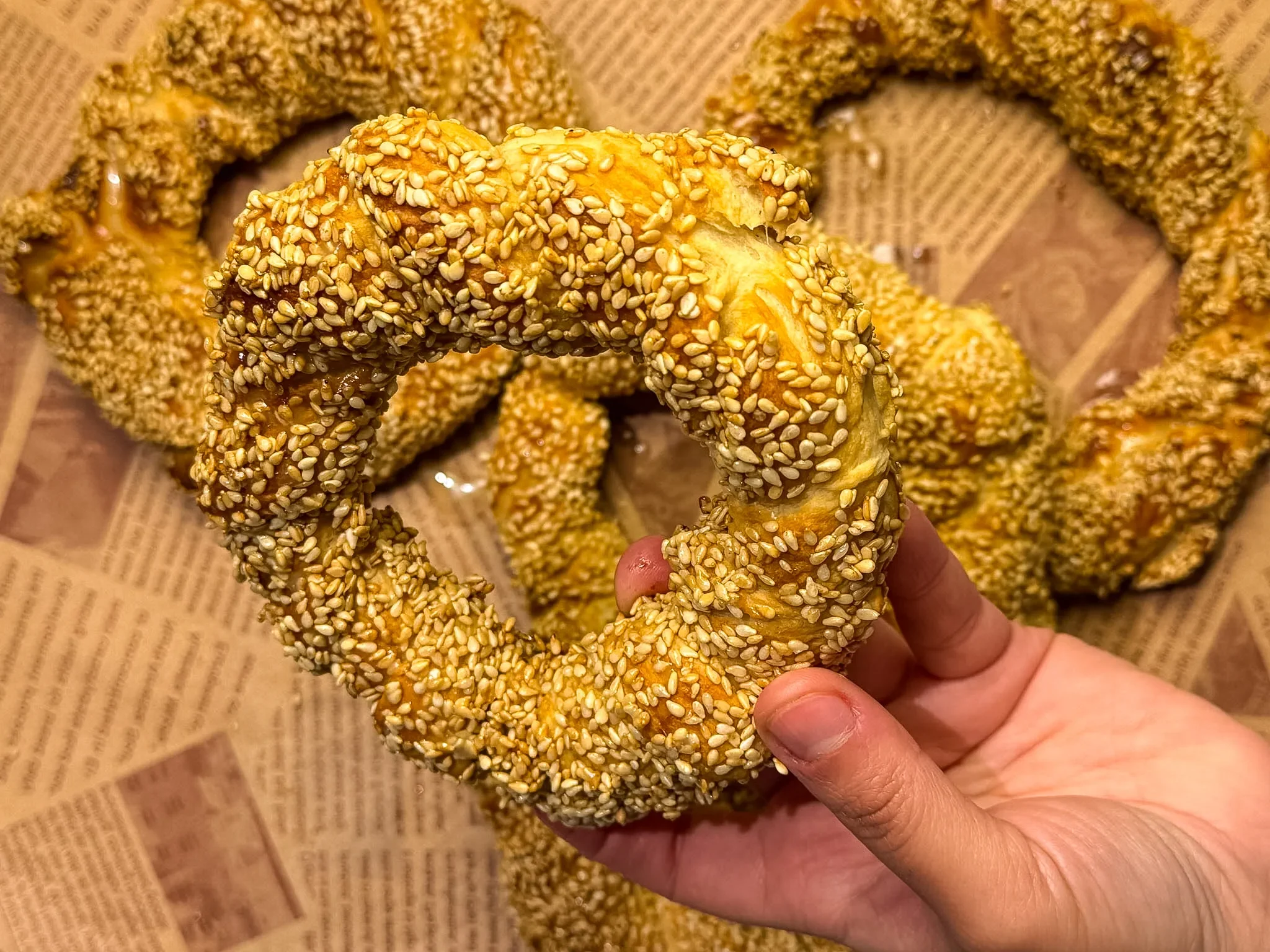
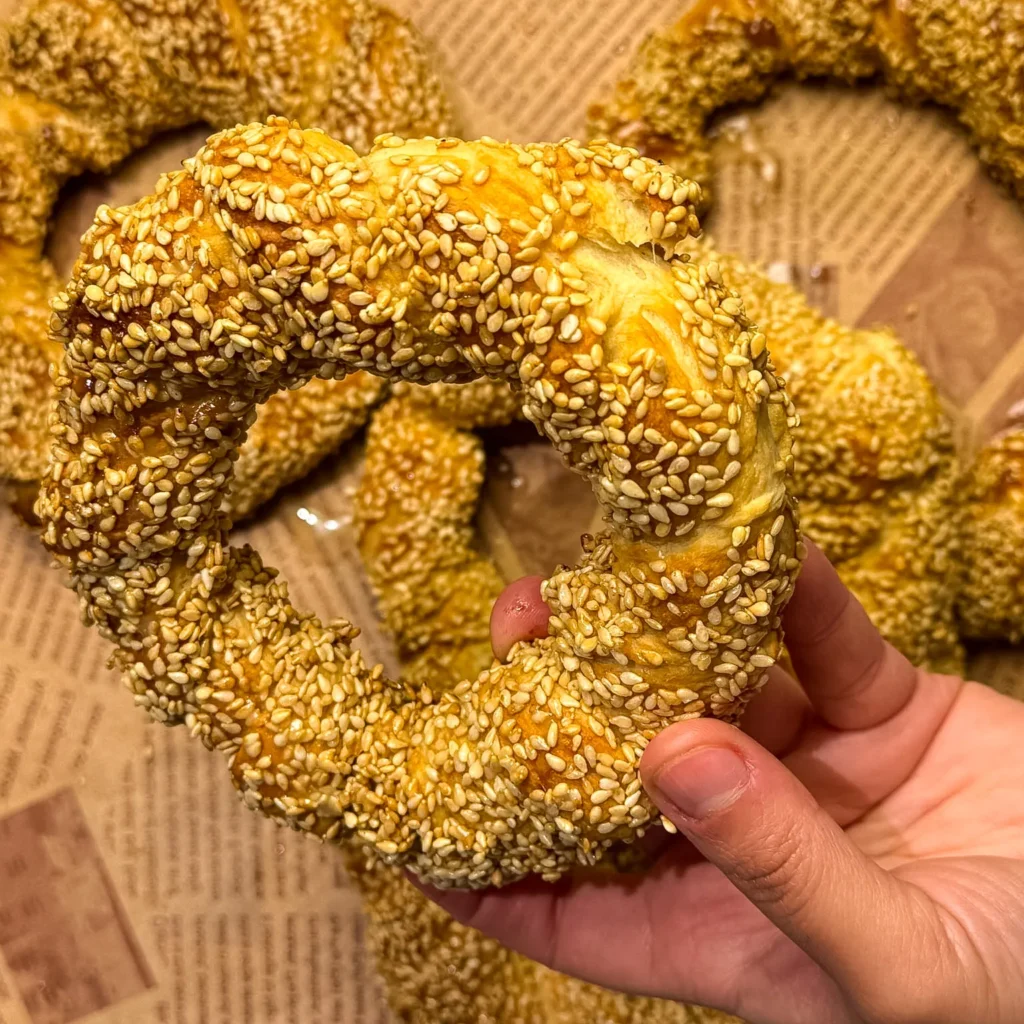
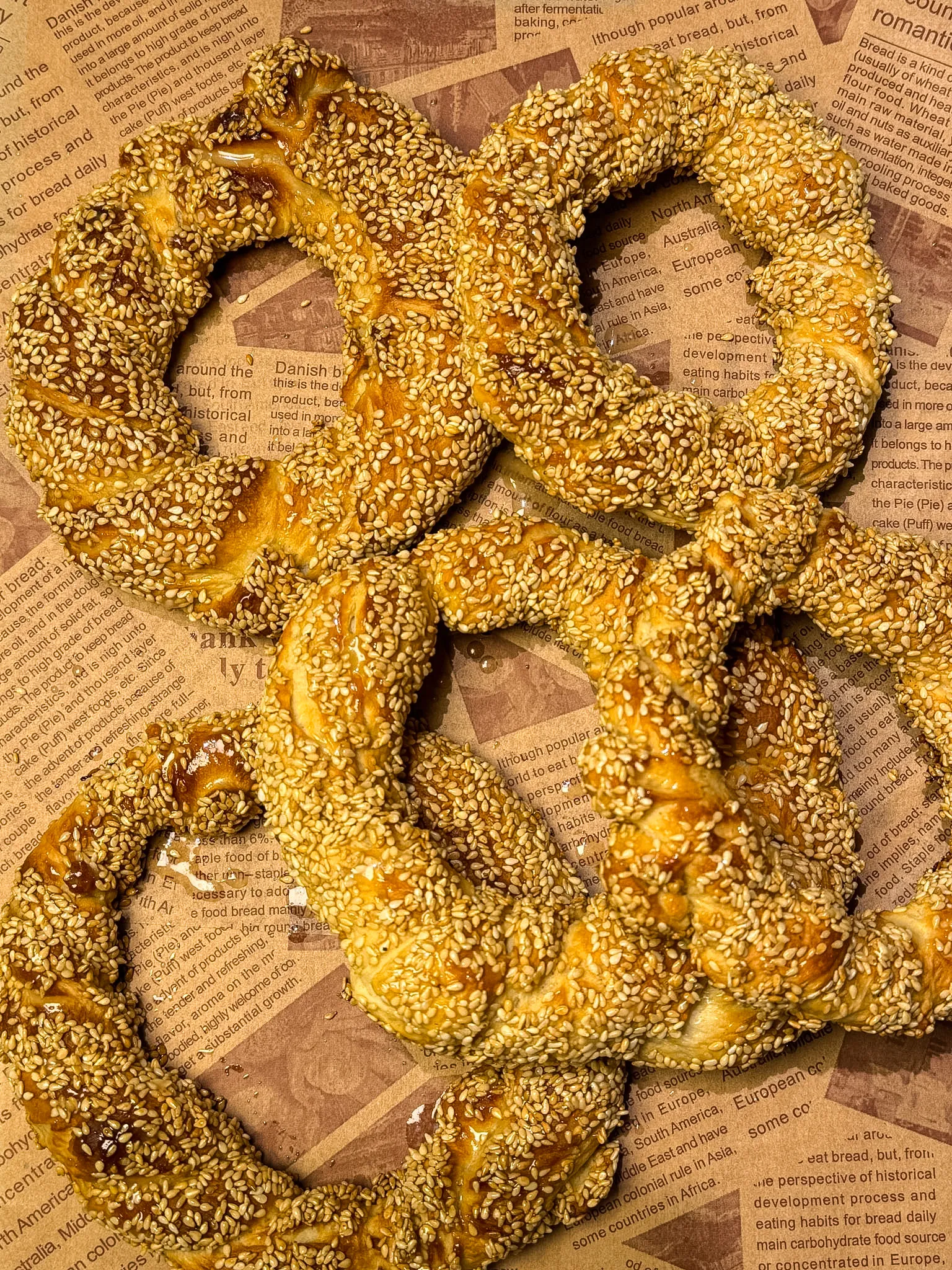
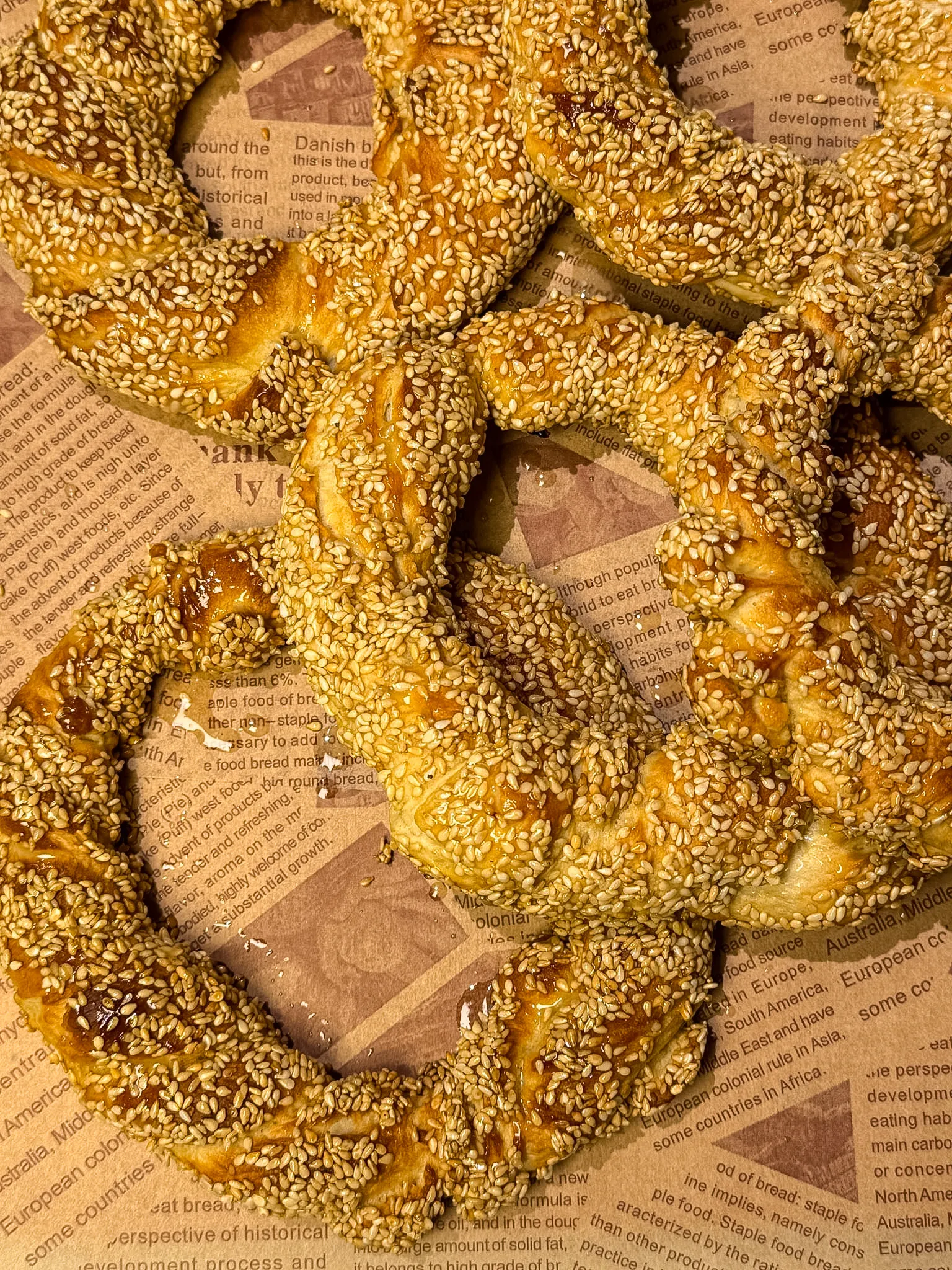
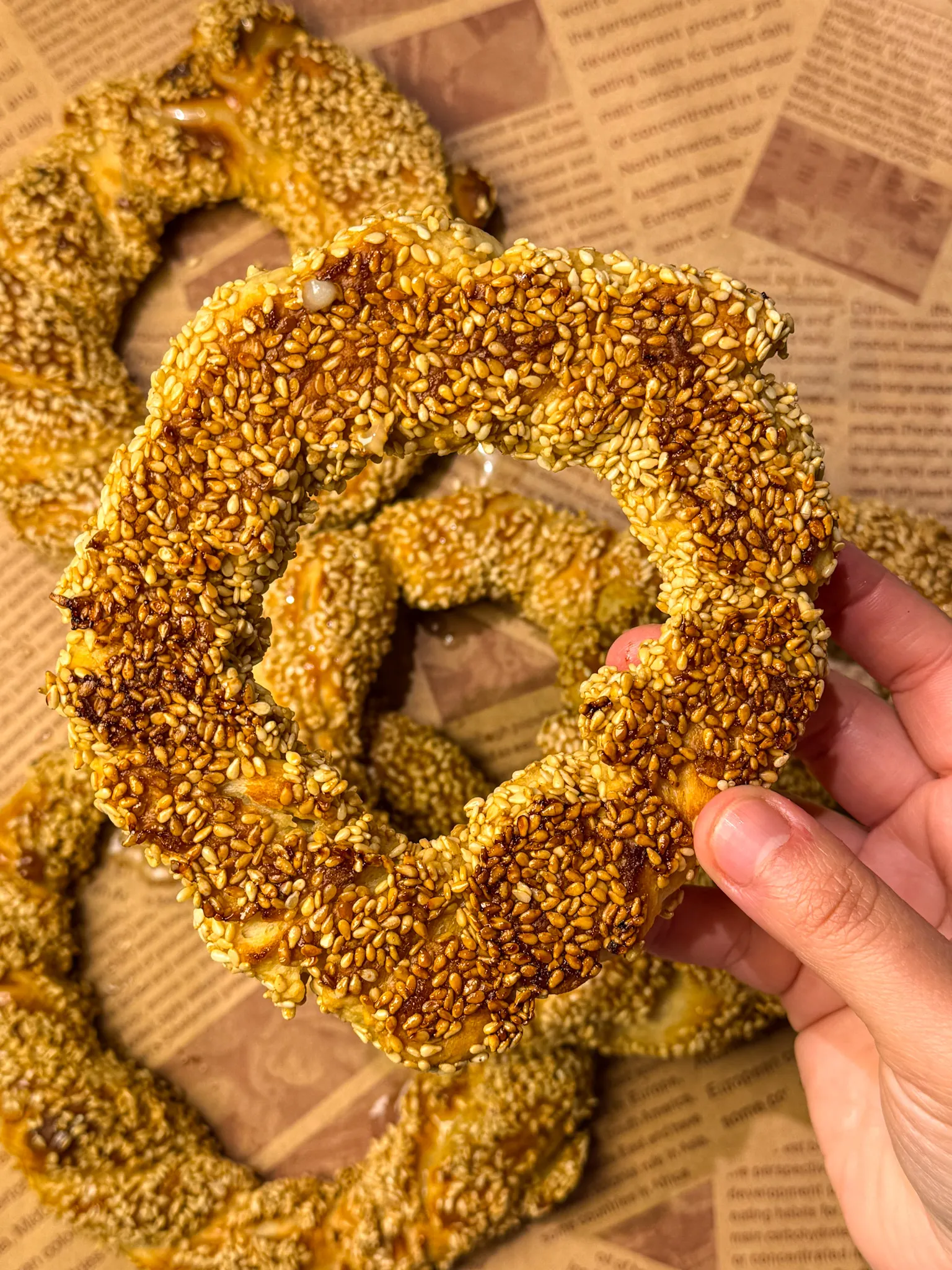
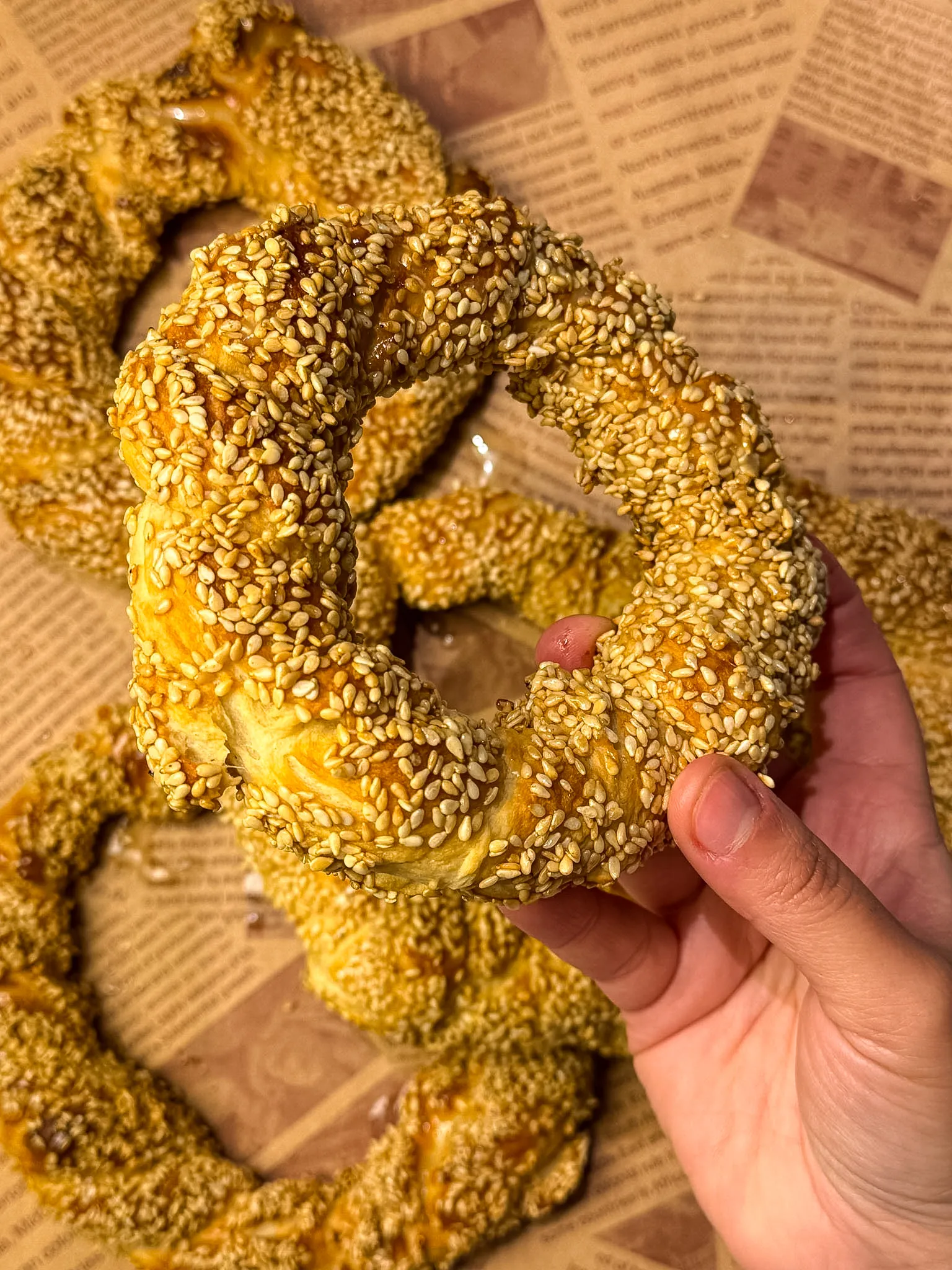
Turkish simit is the bread that belongs to the streets, but feels completely at home in your kitchen once you know how to make it. This golden, sesame-coated bread ring is one of the most recognizable foods in Turkey — sold by street vendors in Istanbul from early morning, eaten with tea, shared without ceremony, and loved by millions of people who have never thought twice about why it is so good. The answer, once you understand it, is simple: Turkish simit is a study in contrasts. The outside is deeply golden and slightly crisp. The inside is soft, airy, and gently chewy.
The sesame coating is thick, nutty, and toasted during baking. And the grape molasses glaze underneath gives the crust a subtle caramelized sweetness that sets this bread apart from anything else in the bakery world. If you already love Turkish baking, you will recognize some of these textural goals in the Turkish Cheese Börek — another recipe that balances crispy exterior with tender, layered interior in a way that feels effortless but requires understanding technique.
Why This Turkish Simit Recipe Is Special
Most homemade Turkish simit recipes produce bread that is technically correct but texturally flat — pale where it should be golden, dry where it should be chewy, or with sesame seeds that fall off the moment you pick it up. The difference between a mediocre homemade simit and one that genuinely rivals the street vendor version comes down to three things: the hydration of the dough, the grape molasses coating, and the oven temperature.
This recipe uses a combination of milk and water rather than water alone. The milk introduces fat and protein into the dough that makes it softer and gives the crumb a more tender, slightly enriched quality. It also contributes to a richer golden color during baking. The combination of butter and oil in the dough adds elasticity and depth — the oil keeps the dough pliable and easy to shape into the long ropes needed for the characteristic ring, while the butter adds a background richness that makes every bite more satisfying.
The grape molasses step is not optional — it is the defining technique of authentic Turkish simit. The molasses mixture creates a sticky surface that holds the sesame seeds during the dip, and then caramelizes in the high-heat oven to form that signature deep golden, slightly shiny crust. Without this step, you are making a sesame-coated bread. With it, you are making Turkish simit.
Key Ingredients Overview
Every ingredient in this Turkish simit recipe serves a specific purpose, and understanding those roles will help you make better decisions if you need to adapt the recipe. The combination of lukewarm milk and lukewarm water creates a balanced liquid base — warm enough to activate the yeast quickly, rich enough to build a soft crumb, light enough to keep the dough from becoming heavy. Sugar feeds the yeast during fermentation and adds a subtle background sweetness that complements the savory sesame coating. Fresh yeast, if you can find it, produces a more active, slightly more complex fermentation than instant yeast — but instant yeast works well too and requires no proofing step.
Oil provides elasticity and keeps the dough from tearing when you roll it into the long ropes needed for shaping. Butter adds a warmth and depth of flavor that makes Turkish simit taste richer than its simple ingredient list suggests. Flour, added gradually, gives you control over the final dough texture — too much produces a dry, tough simit that cracks during shaping. Salt is non-negotiable: bread without it tastes flat regardless of how well everything else is executed. The grape syrup (üzüm pekmezi) is the one ingredient worth seeking out at a Turkish, Greek, or Middle Eastern grocery store.
It is the ingredient that makes Turkish simit taste the way it does, and no other sweetener — not honey, not pomegranate molasses, not simple syrup — produces the same deep caramelization and flavor. And the sesame seeds: use them generously, because they are not decoration — they are flavor, aroma, and texture all at once. If you enjoy the way enriched dough creates soft, tender bread, the Honey Butter Milk Bread Rolls use a similar milk-enriched approach with a different but equally rewarding result.
Understanding the Science Behind Turkish Simit
How Yeast Creates the Airy Interior
When yeast consumes the sugars in the dough, it produces carbon dioxide gas as a byproduct. The gluten network — developed through kneading — traps these gas bubbles throughout the dough. During the first rise, the dough doubles in size as billions of these bubbles accumulate. During baking, the heat causes the bubbles to expand rapidly before the gluten structure sets, giving Turkish simit its light, slightly open crumb. Under-risen dough produces a dense, tight crumb with no air pockets. Over-risen dough collapses in the oven and produces a flat, gummy texture. The 40-minute first rise at room temperature hits the sweet spot for this particular dough hydration and yeast amount.
Why the Grape Molasses Coating Transforms the Crust
Grape molasses is rich in natural sugars — primarily fructose and glucose — that behave very differently from simple table sugar when exposed to heat. In the oven at 225 degrees Celsius, these sugars undergo the Maillard reaction and caramelization simultaneously, producing the deep amber-brown color and complex, slightly bittersweet flavor that distinguishes the crust of authentic Turkish simit. The molasses mixture also creates a sticky surface that holds the sesame seeds firmly against the dough during the coating step. Without it, sesame seeds would need to be pressed in much more aggressively and would still fall off more easily during baking.
How Steam Improves the Crust Quality
Placing a small dish of water at the bottom of the oven creates steam during the first few minutes of baking. Steam keeps the outer surface of the dough moist and flexible, allowing the bread to expand fully before the crust sets. Without steam, the crust can set too quickly and restrict the oven spring, resulting in a smaller, denser simit. The steam also contributes to the characteristic sheen on the finished crust — moisture on the surface reflects more light, giving Turkish simit that glossy, bakery-fresh appearance. After the first five minutes or so, the steam dissipates and the oven dries out, allowing the crust to crisp and develop its final color.
Choosing the Right Ingredients
Flour
All-purpose flour is the correct choice for Turkish simit. It has a moderate protein content (around 10 to 12 percent) that produces a gluten network strong enough to trap gas bubbles and hold the ring shape, but tender enough to create a soft, pleasant crumb. Bread flour, with its higher protein content, can be used but tends to produce a chewier simit that some find too tough. Add the flour gradually — this dough can vary in the amount it needs depending on humidity, the protein content of your specific brand of flour, and the exact size of your eggs if using any.
Grape Molasses
Grape molasses (üzüm pekmezi in Turkish) is the ingredient that makes Turkish simit authentic. It is a concentrated syrup made from cooked-down grape juice, deep brown-black in color and intensely flavored. It is available at Turkish, Greek, Lebanese, and most Middle Eastern grocery stores, as well as online. If you absolutely cannot find grape molasses, the best substitutes in order of preference are: fig molasses (very similar flavor), date molasses (slightly sweeter), carob molasses (earthier). Regular blackstrap molasses is too bitter and is not a suitable substitute. Do not use honey alone — it will make the simit too sweet and will not produce the same crust color.
Sesame Seeds
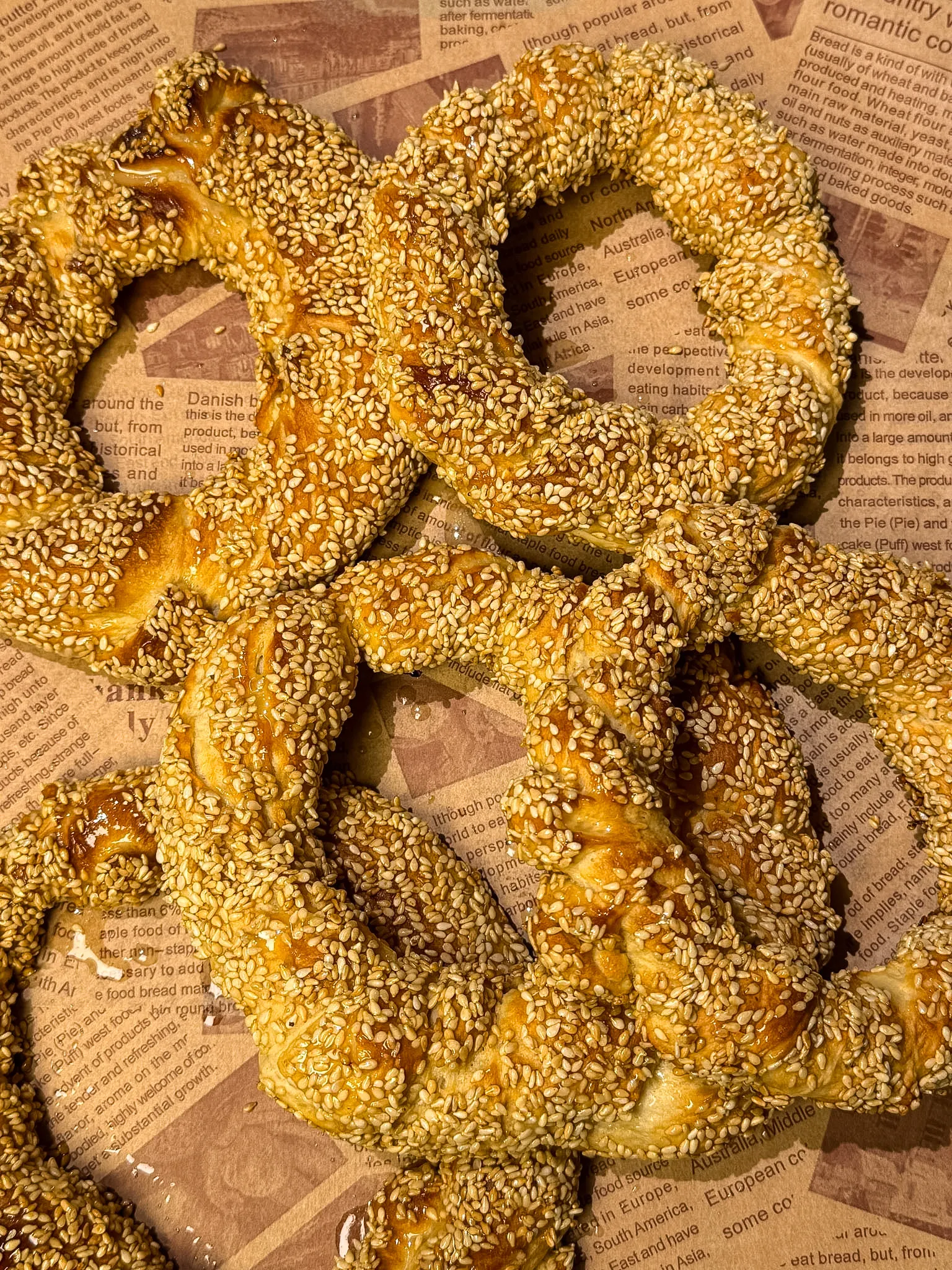
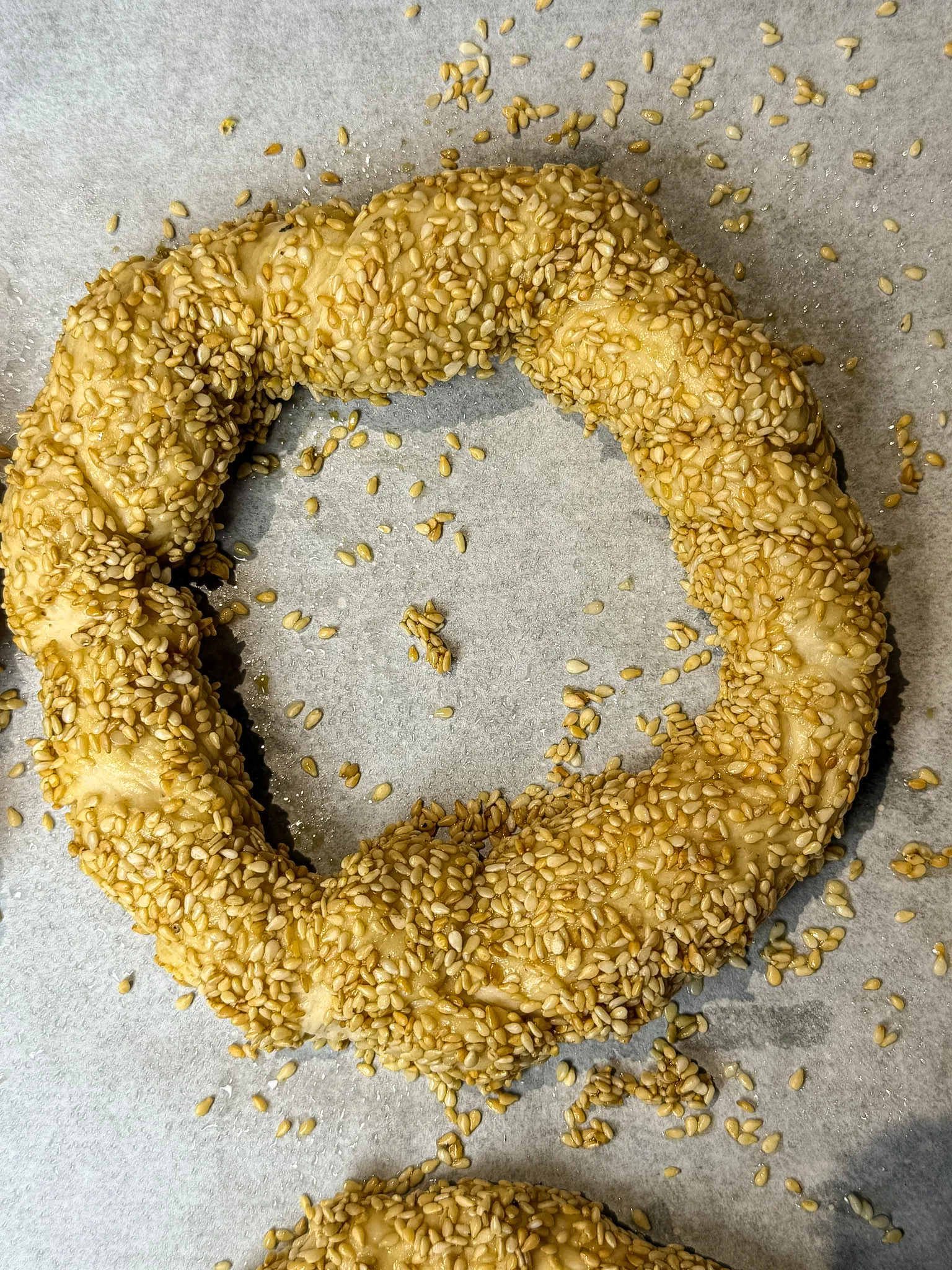
Raw white sesame seeds are what you want. They will toast golden during baking, producing their characteristic nutty aroma and crunch. Pre-toasted sesame seeds can be used but will darken faster in the oven and may over-brown before the bread is fully cooked. Use an amount that seems excessive — you want every square centimeter of the ring’s surface covered. Press the dipped ring gently into the sesame seeds and turn it to ensure full coverage. Sparse sesame coating produces a visually unimpressive and texturally inferior Turkish simit.
Step-by-Step Instructions
Making the Dough
In a large mixing bowl, combine the lukewarm milk, lukewarm water, sugar, and fresh yeast. Stir gently and leave for three to five minutes until the yeast begins to show signs of activity — a slight foamy surface or gentle bubbling. This brief wait confirms the yeast is alive before you invest time in the full dough. Add the oil, softened butter, and salt and stir to combine. Begin adding the flour gradually, about 100 grams at a time, mixing with a wooden spoon or your hands as you go. When the dough becomes too thick to stir, turn it out onto a lightly floured surface and begin kneading.
Work the dough for eight to ten minutes, using the heel of your hand to push, fold, and turn. A properly kneaded dough for Turkish simit should feel soft, smooth, and slightly elastic — it should spring back slowly when you press it with a finger. It should not be sticky enough to leave traces on the counter, but should not be so dry it cracks when you fold it.
First Rise
Shape the kneaded dough into a ball and place it in a lightly oiled bowl. Cover with a clean kitchen towel or plastic wrap and set in a warm, draft-free spot for approximately 40 minutes, until doubled in size. A useful technique: preheat your oven to 30 degrees Celsius, turn it off, and place the bowl inside with the door closed. This creates a consistently warm, humid environment that accelerates and regularizes the rise, which is especially helpful if your kitchen is cool.
Shaping the Rings
Gently punch down the risen dough to deflate it. Divide it into 8 equal pieces — a kitchen scale is the most reliable tool for even division, targeting approximately 80 to 90 grams per piece. Roll each piece into a smooth ball. Then, working with one ball at a time, use both palms to roll it against the counter into a long rope approximately 50 to 60 centimeters in length.
The rope should be even in thickness throughout — thicker in the middle or at the ends leads to uneven cooking. Bring the two ends of the rope together and overlap them by about 3 centimeters, pressing and rolling firmly to seal. The sealed joint is the most vulnerable point of the ring and must be secure — if it opens during baking, the simit loses its shape. Place the finished ring on a lightly floured surface and repeat with the remaining pieces.
Coating with Molasses and Sesame
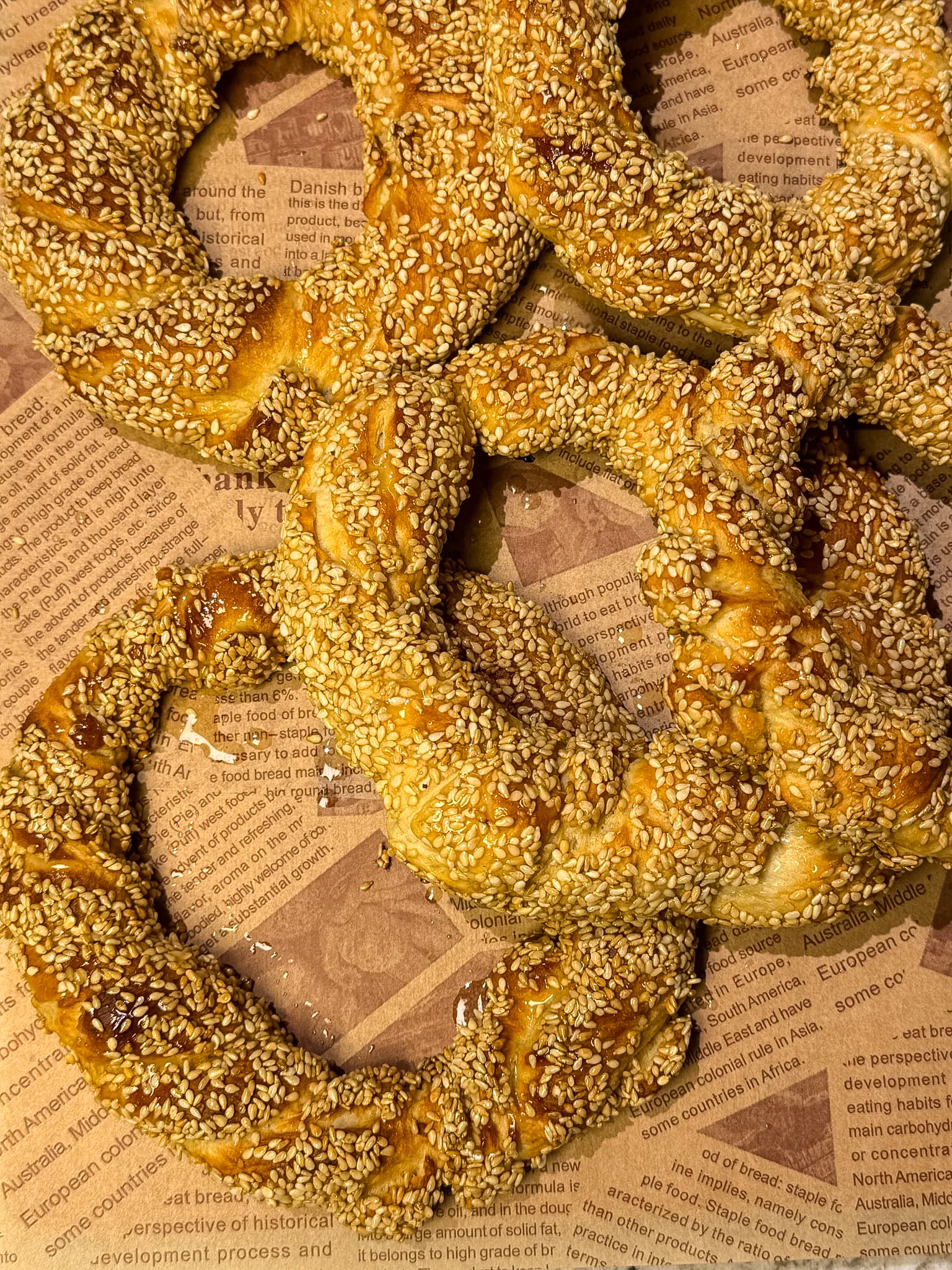
In a wide, shallow bowl, combine the grape syrup and water and stir until fully mixed. Pour the sesame seeds into a separate wide, shallow bowl. Working with one ring at a time, lower it into the molasses mixture and turn it gently to coat both sides completely. Lift it out, allowing the excess to drip for a second or two, then immediately lay it in the sesame seeds. Turn it once, pressing very gently to encourage the seeds to adhere on both sides.
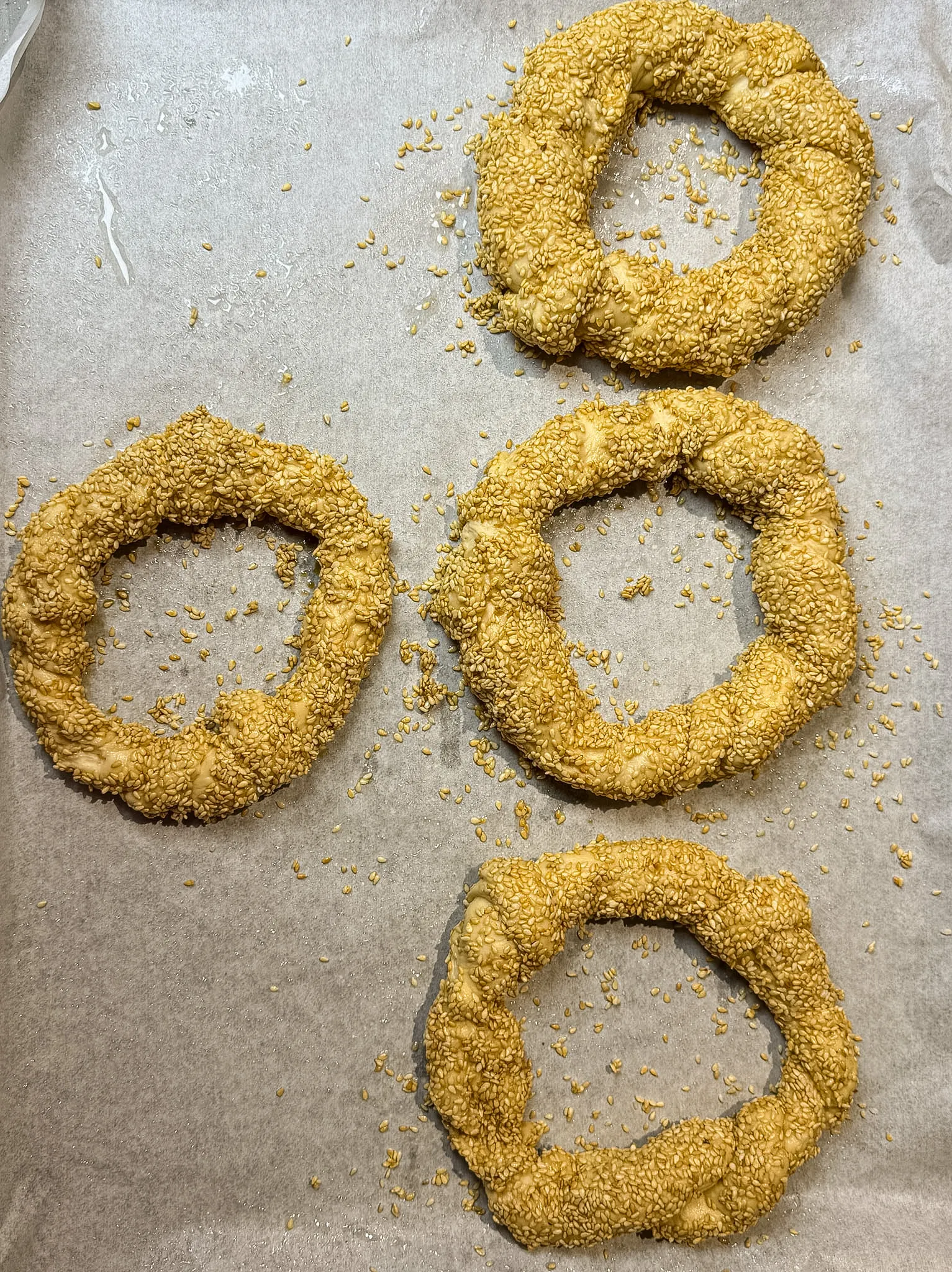
Transfer each coated ring to a baking tray lined with parchment paper, leaving space between them. After all eight rings are coated, let them rest for 15 to 20 minutes. This short second rest allows the yeast to revive slightly after the handling and gives the dough a final lift before baking.
Baking
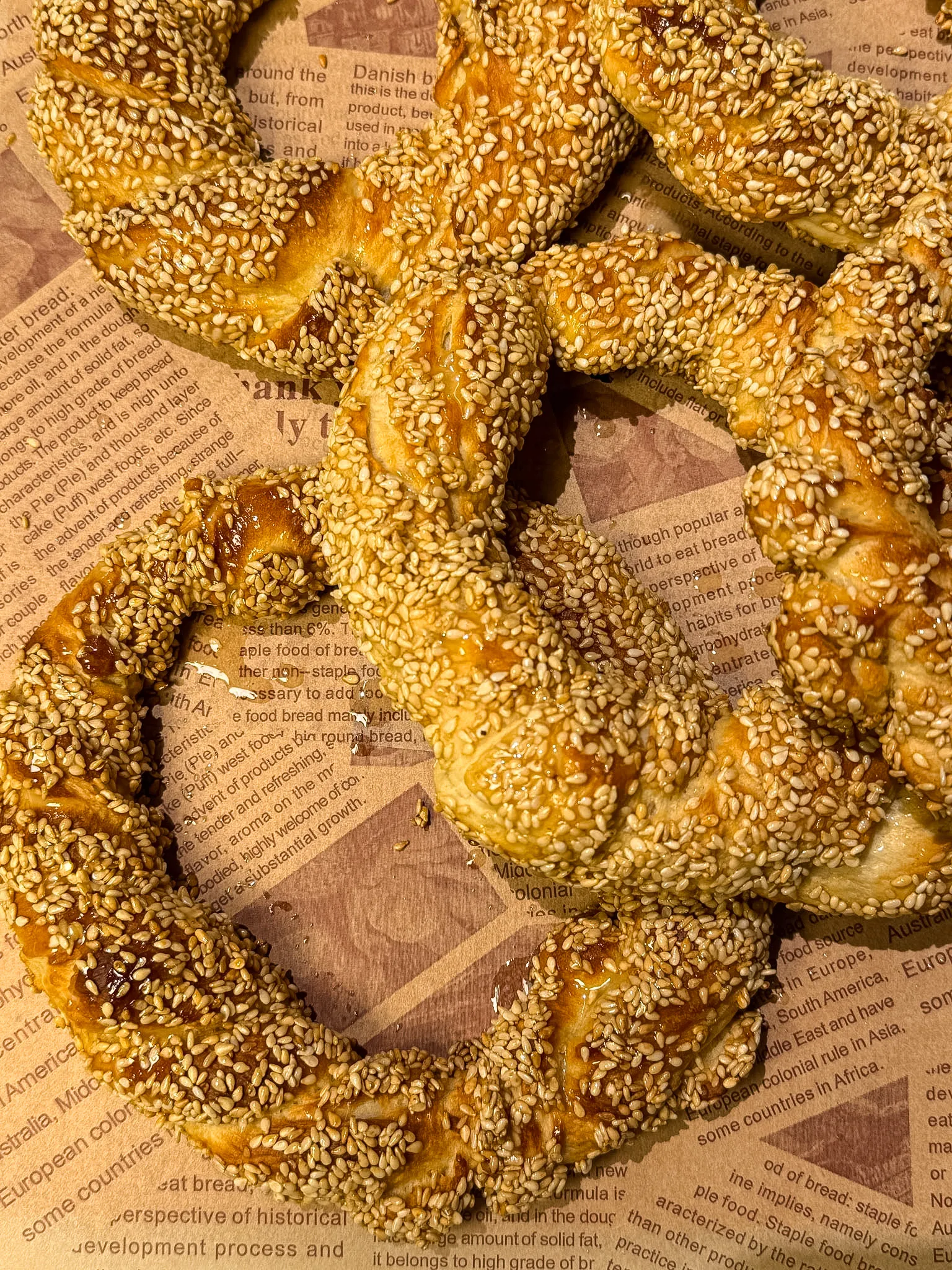
Preheat your oven to 225 degrees Celsius using the convection setting if available. Place a small ovenproof dish filled with hot water on the bottom rack to create steam. Slide the tray of Turkish simit onto the middle rack and bake for approximately 15 minutes. Watch them from about the 12-minute mark — they should be a deep, rich golden brown on the tops and sides, and the sesame should be toasted and nutty-smelling. If they are coloring too fast, reduce the temperature slightly. Remove from the oven and transfer to a wire rack.
Professional Tips for Perfect Results
Use Lukewarm Liquids — Not Hot, Not Cold
The yeast in this dough is sensitive to temperature. Liquids above 43 degrees Celsius will kill the yeast cells before they have a chance to work. Liquids below 25 degrees Celsius will slow the fermentation significantly, making the 40-minute rise time insufficient. Test your liquid temperature against the inside of your wrist — it should feel comfortably warm, the same temperature as a warm bath. This small detail makes the difference between a dough that rises predictably and one that produces dense, flat Turkish simit.
Do Not Rush the Shaping
The long rope-rolling step is where most home bakers lose confidence with Turkish simit. If the dough resists stretching and keeps snapping back, it needs to rest. Cover the piece with a damp cloth for five minutes and try again — the gluten will have relaxed enough to stretch without tearing. Forcing the dough produces uneven ropes that bake unevenly. Patience in the shaping stage is what produces rings that look uniform and professional. If you enjoy the meditative process of working with yeast dough for a beautifully shaped bread, the Salt Butter Bread Recipe is another bread where careful technique produces a visibly superior result.
Be Generous With the Sesame Seeds
The iconic visual appeal of Turkish simit — and much of its flavor — comes from a thick, complete coverage of sesame seeds. Do not try to conserve the seeds. Pour a generous amount into your coating bowl and press each ring into them firmly on both sides. If you can see gaps in the sesame coating after pressing, the ring needs another pass. A thickly sesame-coated simit looks more impressive, tastes nuttier, and has a better crust texture than one where the dough is partially visible through the coating.
Eat It While Warm
Turkish simit is at its absolute best within 20 to 30 minutes of coming out of the oven. At this stage, the crust is slightly crisp, the sesame is fragrant, and the crumb is soft and yielding. As it cools, the crust softens and the interior becomes slightly more compact. This is not a bread that improves with time — it is a bread designed to be eaten fresh.
Street vendors in Istanbul know this, which is why bakeries deliver freshly baked Turkish simit multiple times per day rather than once in the morning. Plan to eat them promptly. If you love Turkish baked goods that are best enjoyed fresh and warm, the Turkish pide follows a similar principle — its texture peaks right out of the oven.
Common Mistakes to Avoid
Pale Simit With Seeds That Fall Off
This result has two causes that are usually present together. First, insufficient grape molasses mixture — if the coating is too thin, the seeds do not adhere properly and the caramelization that drives color development is insufficient. Make sure both sides of each ring are fully wetted in the molasses mixture before dipping into seeds. Second, too-low oven temperature.
Turkish simit needs genuine high heat (220 to 230 degrees Celsius) to develop its characteristic deep golden color. At lower temperatures, the bread cooks but the Maillard reaction and caramelization of the molasses coating do not proceed fully, leaving you with pale, dull simit.
Dense, Heavy Interior
This is almost always the result of insufficient kneading, a short rise time, or dough that is too dry. Under-kneaded dough does not develop enough gluten structure to trap the gas produced by yeast, so the bread stays dense. A rise that is cut short means fewer gas bubbles are present when the bread enters the oven. And dough that is too stiff (from too much flour) cannot expand easily, producing a tight crumb even when properly risen. Always knead for the full eight to ten minutes and verify the dough has genuinely doubled before shaping.
Rings That Open During Baking
The seal where the ends of the rope meet is the structural weak point of Turkish simit. Pressing the ends together is not enough — you need to overlap them by at least 3 centimeters and then roll the joined section firmly against the counter to merge the dough. Placing the simit seam-side down on the baking tray also helps, as the tray surface adds mechanical resistance to the seal separating during the oven spring.
Variations to Try
Whole Wheat Turkish Simit
Replace up to one quarter of the all-purpose flour with whole wheat flour. This adds a slightly nutty, earthier flavor to the dough that complements the sesame coating beautifully. Do not replace more than 25 percent, or the gluten development will be compromised and the rings will be dense. The whole wheat version has a slightly denser crumb but a more complex flavor that many people prefer for savory pairings with cheese and olives.
Mixed Seed Turkish Simit
Use a blend of sesame seeds, black sesame seeds, and poppy seeds for a more visually striking and texturally varied coating. The three seed varieties have different roasting rates, so watch the oven more carefully — black sesame in particular can look done before the bread underneath is fully cooked. This variation makes a beautiful breakfast centerpiece on a board with cheeses, olives, and sliced vegetables.
Stuffed Turkish Simit
Before shaping the rings, flatten each piece of dough slightly and place a strip of kaşar cheese or a thin slice of cured beef along the center. Roll the dough around the filling and proceed with the rope-rolling and ring-forming steps. The filling melts into the interior during baking, creating a more substantial, savory simit that works as a complete snack or light meal.
This variation is inspired by bakery variations you can find in Istanbul neighborhoods. For another example of Turkish pastry filled with rich, savory cheese filling, the Turkish Meat Borek is a wonderful companion recipe that uses similar filling principles in a different format.
Storage and Reheating
Room Temperature
Turkish simit is always best eaten the day it is baked, ideally within the first hour. If you have leftovers, store them in a paper bag at room temperature for up to one day — a paper bag allows a small amount of air circulation that helps the crust stay drier than an airtight container, which traps moisture and softens the crust rapidly.
Refrigeration
Refrigeration is not recommended for Turkish simit. Cold temperatures stale bread rapidly by causing the starch molecules to recrystallize, a process called retrogradation. Refrigerated simit becomes dense and dry much faster than room-temperature storage. If you need to keep it longer than one day, freezing is a better option.
Freezing
Allow the simit to cool completely after baking. Slice each ring in half — like a bagel — before freezing so you can defrost individual portions. Wrap tightly in plastic wrap and place in a freezer bag. Freeze for up to two months. Defrost at room temperature for an hour or toast directly from frozen.
Reheating
The oven is the only method that properly revives Turkish simit. Place the stored bread in a preheated oven at 180 degrees Celsius for four to five minutes. This restores the crust’s crispness and warms the interior without over-drying the crumb. Avoid the microwave — it heats the bread unevenly, softens the crust irreversibly, and produces a chewy, gummy texture. Even a toaster oven produces significantly better results than a microwave for reheating this bread.
Frequently Asked Questions
What is Turkish simit?
Turkish simit is a circular sesame-covered bread ring that is one of the most iconic and widely consumed street foods in Turkey. It has been sold by street vendors — called simitçi — from carts and large round trays balanced on their heads since the Ottoman period. The bread is characterized by its twisted ring shape, thick sesame seed coating, and the deep golden color produced by a grape molasses glaze applied before baking. It is most commonly eaten for breakfast alongside Turkish tea, feta cheese, olives, and tomatoes.
Is simit the same as a bagel?
Turkish simit is frequently called a “Turkish bagel” in English-language descriptions, but the two breads are technically quite different. Bagels are boiled in water before baking, which gives them a dense, chewy, shiny crust. Turkish simit is not boiled — it is simply coated in the molasses mixture and baked directly. This produces a much lighter, airier interior and a crust that is crispy rather than shiny and chewy. The flavor is also very different: bagels are relatively neutral in flavor, while Turkish simit has the caramelized sweetness of grape molasses and the pronounced nuttiness of toasted sesame seeds.
What can I substitute for grape molasses in Turkish simit?
Grape molasses (üzüm pekmezi) is the authentic ingredient, but if you cannot find it, the best alternatives are fig molasses or date molasses — both produce a similar depth of color and flavor without the bitterness of blackstrap molasses. Pomegranate molasses can be used but has a more sour, tart character that changes the flavor of the crust noticeably. Some recipes use diluted honey, but this produces a sweeter, paler simit that lacks the characteristic depth. Avoid blackstrap molasses entirely — it is too bitter and will produce an unpleasant, acrid crust.
How do you eat Turkish simit?
Turkish simit is traditionally eaten for breakfast, served alongside hot tea, white cheese (beyaz peynir or feta), sliced tomatoes, cucumbers, and olives. It can also be eaten as a snack throughout the day, plain or spread with butter, jam, tahini and grape molasses (a combination called tahin pekmez), or Nutella. In urban areas, Turkish simit is commonly eaten as street food — torn apart while walking or eaten while sitting on a bench. For a more substantial meal, it can be sliced in half and used as the base for a sandwich filled with cheese, vegetables, or cured meats.
Why are my sesame seeds falling off the simit?
Seeds fall off when the molasses coating is too thin or when the seeds are not pressed firmly enough into the surface. Make sure each ring is fully submerged in the molasses mixture and coats evenly on both sides before pressing into the seeds. After coating, press each ring down gently with your palm to encourage the seeds to set into the sticky surface. If seeds are still falling off after baking, try using slightly less water in the molasses mixture to make it more viscous and adhesive.
How long does Turkish simit last?
Turkish simit is best eaten within two hours of baking. After that, the crust softens and the crumb begins to compact. At room temperature in a paper bag, it will remain pleasant to eat for one full day — though noticeably less vibrant than fresh. After 24 hours at room temperature, it is best reheated in the oven before eating. For longer storage, freeze immediately after cooling and reheat directly from frozen in the oven.
Watch the recipe video for more clarity!
See our similar recipes:
People also like these recipes:
Final Thoughts
Turkish simit is the kind of recipe that rewards every baker who takes the time to understand it properly. It looks simple — and in terms of ingredients, it is — but the techniques behind the grape molasses coating, the shaping, and the high-heat baking are what transform basic dough into something that genuinely transports you to a street corner in Istanbul. Once you make Turkish simit successfully the first time, you will understand immediately why people who have grown up eating it describe it the way they do: not just as bread, but as a daily ritual and a sensory memory.
The process is forgiving once you understand the two or three non-negotiable steps — proper dough hydration, generous molasses coating, and a fully preheated oven at high temperature. Everything else is adjustable and improvable with practice. Your second batch of Turkish simit will be better than your first, and your third better still, as you develop an intuitive feel for the dough texture and the coating thickness that produces the result you want.
Bake a batch on a weekend morning, set it out with feta cheese, olives, and a pot of strong black tea, and share it while it is still warm. That is how Turkish simit is supposed to be eaten, and that is when you will understand why it has been part of everyday life in Turkey for centuries.
- 170 ml milk
- 170 ml water
- 2.5 tsp sugar
- 20 g fresh yeast
- 2.5 tbsp oil
- 1 tbsp butter
- 1 tsp salt
- 500 –550 g flour
Coating:
- 100 ml grape syrup
- 100 ml water
- sesame seeds
Mix milk, water, sugar, and yeast.
Add oil, butter, salt, and flour.
Knead into soft dough.
Let rise 40 minutes.
Divide into 8 pieces.
Shape into rings.
Dip in syrup mixture.
Coat with sesame seeds.
Let rest 15–20 minutes.
Bake at 225°C for 15 minutes.
If you've given this recipe a try and it won you over, please share your thoughts by leaving
a rating and comment below! If you have any questions about this recipe, don't hesitate to ask – I'm here to
help and will respond promptly.