Introduction
If you have been looking for the perfect kunafa rolls recipe, you have found it. This is the dessert that combines the golden crispiness of phyllo pastry, the buttery richness of ghee-soaked kunafa strands, and the sweet, fragrant pull of lemon sugar syrup into something so completely addictive that a single bite is rarely enough. A great kunafa rolls recipe creates rolls that are crunchy on the outside, slightly chewy and nutty within, and finished in a glossy syrup that clings to every layer without ever making them soggy. This is the balance that defines truly excellent kunafa rolls, and this recipe achieves it every single time.
What makes this kunafa rolls recipe stand out from others is its clarity about why each step matters. The reason the kunafa strands are broken apart before mixing with ghee is not arbitrary — it determines the texture of the entire filling. The reason the rolls are arranged tightly in a greased tray before baking is not for aesthetics — it keeps them from unraveling as the pastry expands in the heat. The reason the syrup is poured immediately over hot rolls is not just tradition — it is the technique that produces even absorption without sogginess. Understanding these reasons turns a good kunafa rolls recipe into a great one.
Whether you are making this kunafa rolls recipe for Ramadan, Eid, a celebration, or simply because you want an extraordinary dessert to share, the result will be a tray of golden, fragrant, syrupy rolls that look and taste like something from a professional pastry shop. Once you make this kunafa rolls recipe once, you will understand immediately why it has become one of the most searched and most shared desserts on the internet.
Why This Kunafa Rolls Recipe Is Special
This kunafa rolls recipe is a fusion of two of the most celebrated desserts in the Middle East. Baklava brings the concept of thin, layered pastry soaked in syrup and filled with nuts. Kunafa brings the buttery, crispy shredded pastry strands that produce a texture unlike anything else in the world of baked desserts. When the two are combined in this kunafa rolls recipe, the result is a dessert that honors both traditions while creating something entirely its own.
The phyllo pastry wrapping is what gives each roll its structure and its most visible crispiness. The outer shell of every piece in this kunafa rolls recipe is formed by two to three layers of thin phyllo, brushed generously with ghee and rolled tightly around the kunafa filling. In the oven, these layers crisp and bronze beautifully, creating a satisfying shatter with every bite. Beneath that phyllo shell, the kunafa strands provide a second layer of crispiness that is slightly softer and chewier than the outer crust, adding depth and complexity to the texture of the kunafa rolls recipe.
The nut filling is the third element and one of the most important for flavor. A combination of crushed pistachios and chopped walnuts delivers both the distinct, slightly savory richness of pistachio and the deeper, earthier quality of walnut. Together they create a filling that is complex and satisfying in a way that either nut alone cannot achieve. This kunafa rolls recipe uses both for exactly that reason, and the result in every bite reflects the difference.
For a broader exploration of Middle Eastern desserts that share the same tradition of syrup-soaked pastry and nutty fillings, the HOMEMADE TURKISH BAKLAVA on this site is an outstanding companion recipe that demonstrates the baklava half of this kunafa rolls recipe’s inspiration in its most traditional form.
Key Ingredients Overview
A well-made kunafa rolls recipe depends on understanding what each ingredient is actually doing in the dessert and why its quality matters.
Phyllo pastry is the outer shell of every roll in this kunafa rolls recipe. Each sheet is paper-thin, fragile, and prone to drying out within minutes of exposure to air. Good-quality phyllo bakes into a uniformly golden, crisp crust that shatters cleanly on the bite. Inferior or improperly thawed phyllo tears during rolling, produces pale, soft patches after baking, and undermines the entire presentation of the finished kunafa rolls recipe.
Kunafa pastry — also called kataifi dough or shredded phyllo — consists of fine, thread-like strands of dough that, when coated in ghee and baked, become crispy, slightly caramelized, and deeply fragrant. In this kunafa rolls recipe, the strands are broken apart by hand until loose and airy, then mixed with ghee and powdered sugar before being placed inside the phyllo rolls. This technique ensures that every strand is coated with fat before baking, producing a filling that crisps evenly throughout rather than remaining dry and pale in the center.
Ghee is the fat that makes this kunafa rolls recipe taste distinctly and authentically Middle Eastern. Its milk solids have been removed, which means it tolerates the heat of the oven without burning at the edges and produces a cleaner, more golden result than whole butter. Its flavor — nutty, slightly caramelized, and deeply rich — infuses every layer of both the phyllo wrapping and the kunafa filling with a characteristic warmth that is central to the identity of this dessert. A kunafa rolls recipe made with plain butter will still be good; a version made with ghee will be exceptional.
Pistachios and walnuts form the nut layer within the kunafa filling. Raw pistachios, pulsed briefly to a coarse rubble in a food processor, provide a vivid green color, a slightly savory richness, and a crunch that contrasts beautifully with the softer, chewier texture of the kunafa strands. Walnuts, roughly chopped, add a deeper flavor and a more irregular texture that makes every bite slightly different from the last. This combination is the foundation of the filling in this kunafa rolls recipe and should not be reduced or replaced with a single nut type if the full depth of flavor is the goal.
The sugar syrup is the final and arguably most critical component of this kunafa rolls recipe. It is what transforms a tray of well-baked rolls into a finished dessert. The syrup is made from a simple combination of sugar, water, and lemon juice, cooked briefly until the sugar is fully dissolved and the liquid has thickened slightly. The lemon juice serves a dual purpose: it adds a subtle brightness that prevents the syrup from tasting one-dimensional, and its citric acid inhibits sugar crystallization, keeping the syrup liquid and glossy even as it cools.
Understanding the Science Behind This Kunafa Rolls Recipe
Why Breaking Apart the Kunafa Strands Matters
The kunafa strands used in this kunafa rolls recipe are tightly packed together when they come out of the package, pressed into a dense mat of dough that would bake into a heavy, uneven filling if used without preparation. Breaking the strands apart by hand until they are loose and separate — not ground into a powder, but simply separated into individual threads — allows the ghee to coat every strand individually during mixing. When every strand carries a thin layer of fat into the oven, every strand crisps evenly, producing a filling in this kunafa rolls recipe that is light, golden, and consistently textured rather than dense and pale in patches.
How Tight Rolling Produces Crispy Results
The tightness with which each roll is assembled in this kunafa rolls recipe directly determines the quality of the finished crust. A loosely rolled kunafa rolls recipe piece will unravel slightly in the oven as the pastry expands and the filling shifts. This creates gaps between the phyllo layers that fill with steam rather than crisping, producing a soft, slightly flabby result. A tightly rolled piece compresses the layers together so that the fat between each one encourages uniform crisping across the entire surface. Rolling this kunafa rolls recipe tightly is not a matter of aesthetics — it is one of the most important techniques in the entire process.
The Hot Pastry, Warm Syrup Principle
The syrup timing in this kunafa rolls recipe follows the same principle as traditional baklava. When the freshly baked rolls, straight from the oven at full temperature, receive a pour of warm syrup, capillary action draws the liquid rapidly inward through the cracks and crevices in the pastry layers. The heat of the rolls accelerates this absorption, and the sugar in the syrup begins to set almost immediately as it encounters the slightly cooler layers within. The result is a kunafa rolls recipe that is sweet and fragrant all the way through without ever becoming wet or disintegrating.
Cold pastry absorbs syrup slowly and unevenly, and syrup that is too hot will steam the outer layers and soften them before they can set. This kunafa rolls recipe depends on warm syrup meeting hot pastry at exactly the right moment.
Choosing the Right Ingredients
Selecting Fresh Kunafa Pastry
For this kunafa rolls recipe, fresh kunafa dough will always produce a superior result to frozen. Fresh strands are more pliable, break apart more easily without crumbling, and absorb ghee more evenly during the mixing stage. If fresh kunafa is not available and you are using frozen dough for this kunafa rolls recipe, thaw it completely in the refrigerator overnight and allow it to come to room temperature for 30 minutes before opening the package. Keep the unused dough covered with a lightly damp kitchen towel throughout the assembly process, as kunafa strands dry out and become brittle very quickly when exposed to air.
Choosing the Right Phyllo
The phyllo used to wrap the rolls in this kunafa rolls recipe should be as thin as possible. Standard #4 or #7 phyllo, widely available in Middle Eastern grocery stores and many supermarkets, works perfectly. Thicker phyllo sheets will produce a chewier, more bread-like crust rather than the shatteringly thin, crispy exterior this kunafa rolls recipe requires. Keep phyllo covered with a damp cloth while working, and never attempt to use sheets that have dried out, as they will crack during rolling and produce ragged, uneven rolls.
Ghee vs. Clarified Butter for This Kunafa Rolls Recipe
Authentic ghee, which has been cooked slightly longer than clarified butter to caramelize the milk solids before their removal, produces a noticeably more complex and nutty flavor in this kunafa rolls recipe. The difference is most obvious in the kunafa filling, where the ghee is mixed directly with the dough strands and its flavor comes through clearly in every bite. Clarified butter is a serviceable substitute and will produce a kunafa rolls recipe that is still excellent, particularly if ghee is difficult to source locally.
Step-by-Step Instructions
Preparing the Syrup
Begin the syrup before anything else, as it needs time to cool to the right temperature for pouring. Combine 3 cups of granulated sugar, 3 cups of water, and the juice of half a lemon in a medium saucepan over medium heat. Stir gently until the sugar dissolves completely, then bring to a gentle boil. Reduce the heat and simmer for 10 minutes until the syrup has thickened slightly and coats the back of a spoon lightly. Remove from the heat and set aside at room temperature. By the time the kunafa rolls recipe is baked and out of the oven, the syrup will have cooled to the ideal warm temperature for absorption.
Preparing the Kunafa Filling
Open the kunafa pastry package and transfer the strands to a large bowl. Using your hands, break the strands apart gently until they are completely separated and loosely fluffy rather than matted together. This step is essential for the texture of the finished kunafa rolls recipe — do not skip it or rush through it. Add 3 tablespoons of powdered sugar and 4 tablespoons of melted ghee. Toss the strands thoroughly with your hands or two forks until every strand is lightly coated with the ghee and sugar mixture. The filling should smell rich and slightly sweet at this stage.
Preparing the Nut Layer
Place 100 grams of raw shelled pistachios in a food processor and pulse 4 to 5 times until the nuts form a coarse rubble with pieces ranging from the size of a grain of rice to a small pea. Transfer to a bowl. Add 100 grams of roughly chopped walnuts and stir to combine. Set aside. This nut mixture forms the inner core of the kunafa rolls recipe and provides both flavor and crunch within the softer kunafa filling.
Rolling and Assembling the Kunafa Rolls
Preheat your oven to 180°C (350°F). Brush a large rectangular baking tray generously with melted ghee and set aside. Lay a sheet of phyllo pastry flat on a clean work surface. If the sheet is large, cut it in half so you are working with a manageable rectangle approximately 25 centimeters wide. Keep all unused phyllo covered with a damp towel. Brush the surface of the phyllo sheet generously with melted ghee. Place a small line of the kunafa filling along the edge nearest to you, forming a line about 3 centimeters wide and leaving 2 centimeters clear at each end.
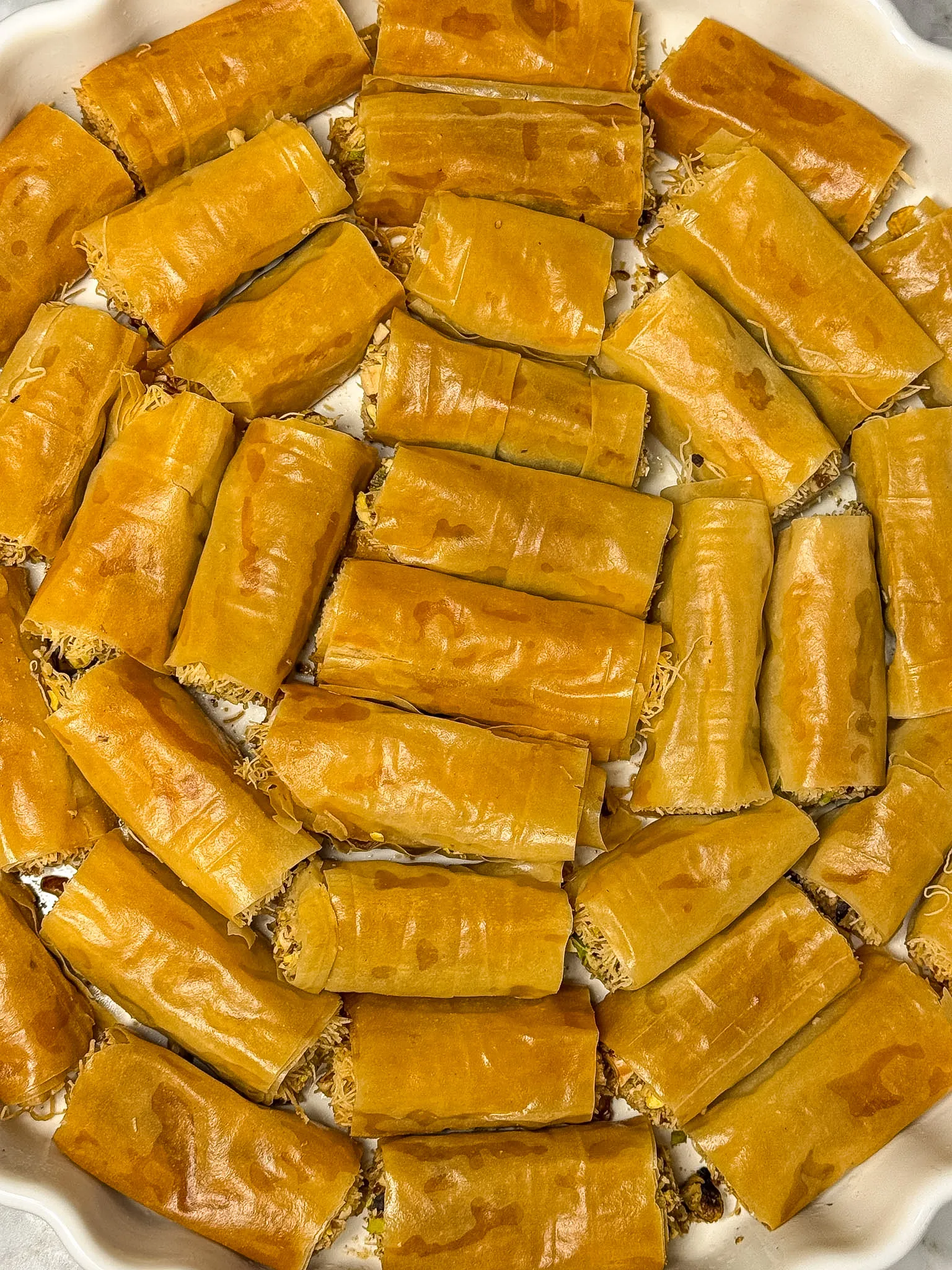
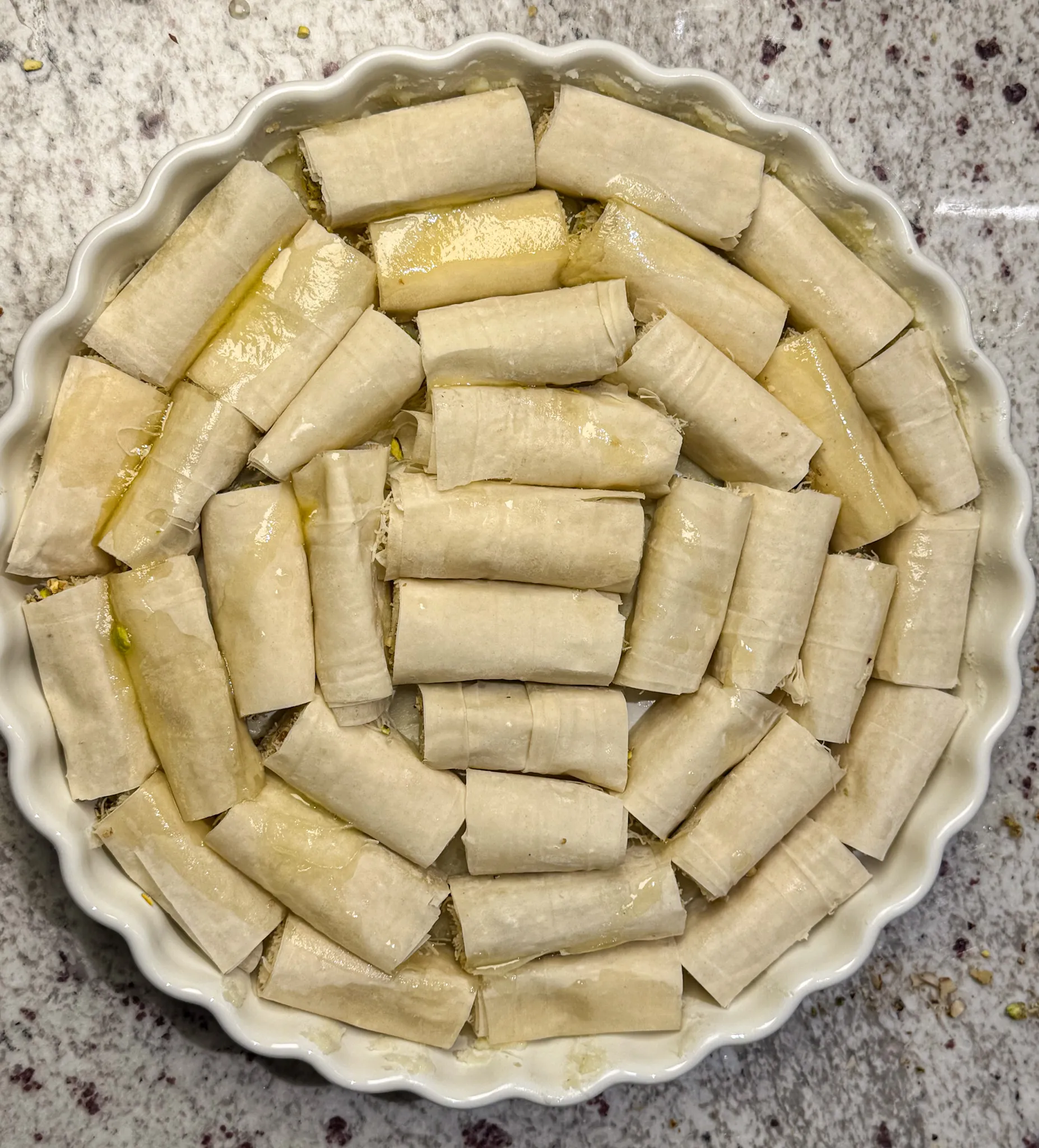
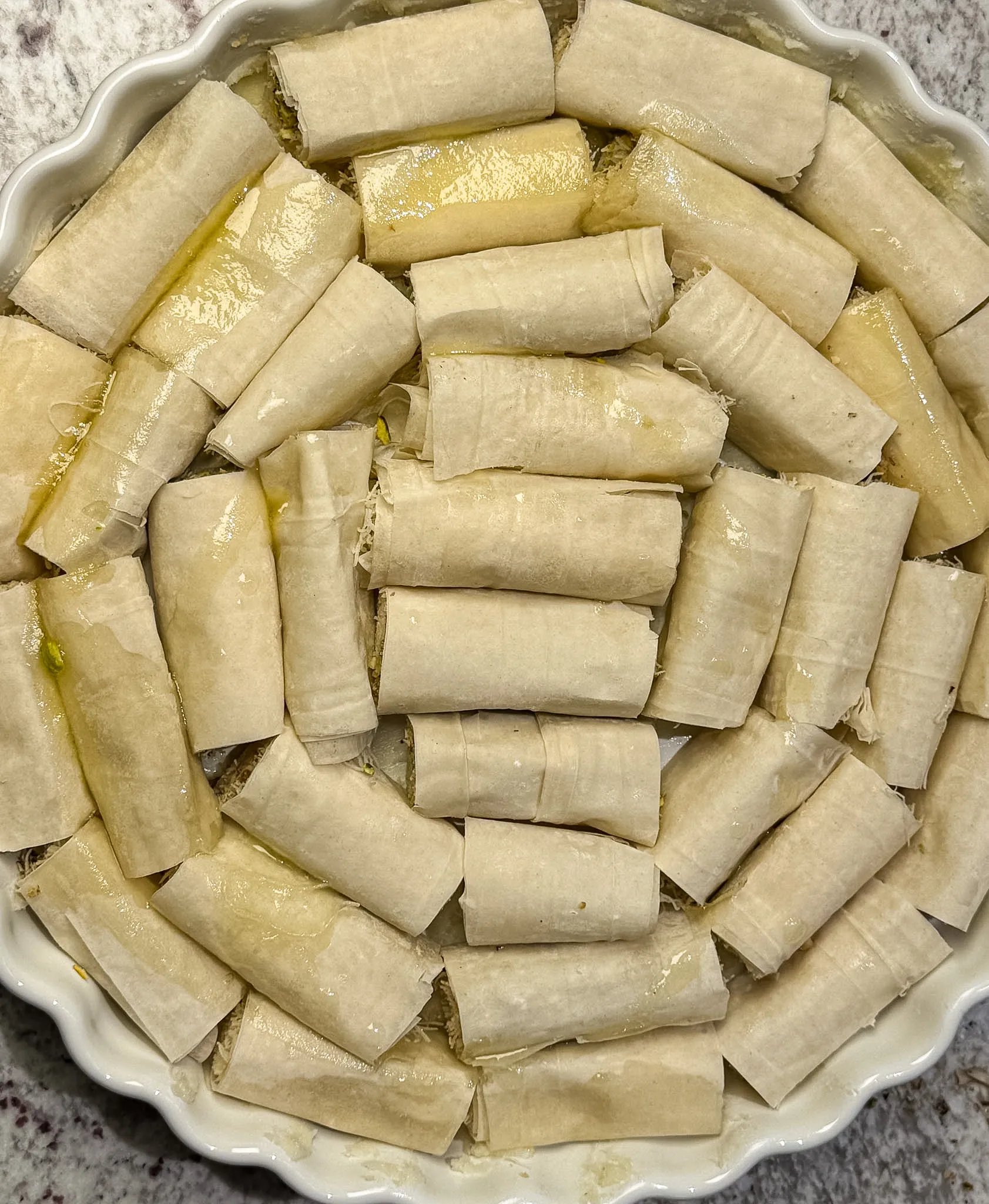
Scatter a pinch of the nut mixture over the kunafa filling. Roll the phyllo away from you tightly around the filling, keeping the sides tucked in as you go. Before the final roll, brush the far edge with a small amount of ghee to seal the roll. Place the completed roll seam-side down in the greased tray. Repeat with the remaining filling until the tray is full, arranging the rolls snugly together. Cut the assembled rolls into bite-sized pieces approximately 4 to 5 centimeters long using a sharp knife. Brush the tops of all the cut rolls generously with the remaining melted ghee.
Baking and Glazing
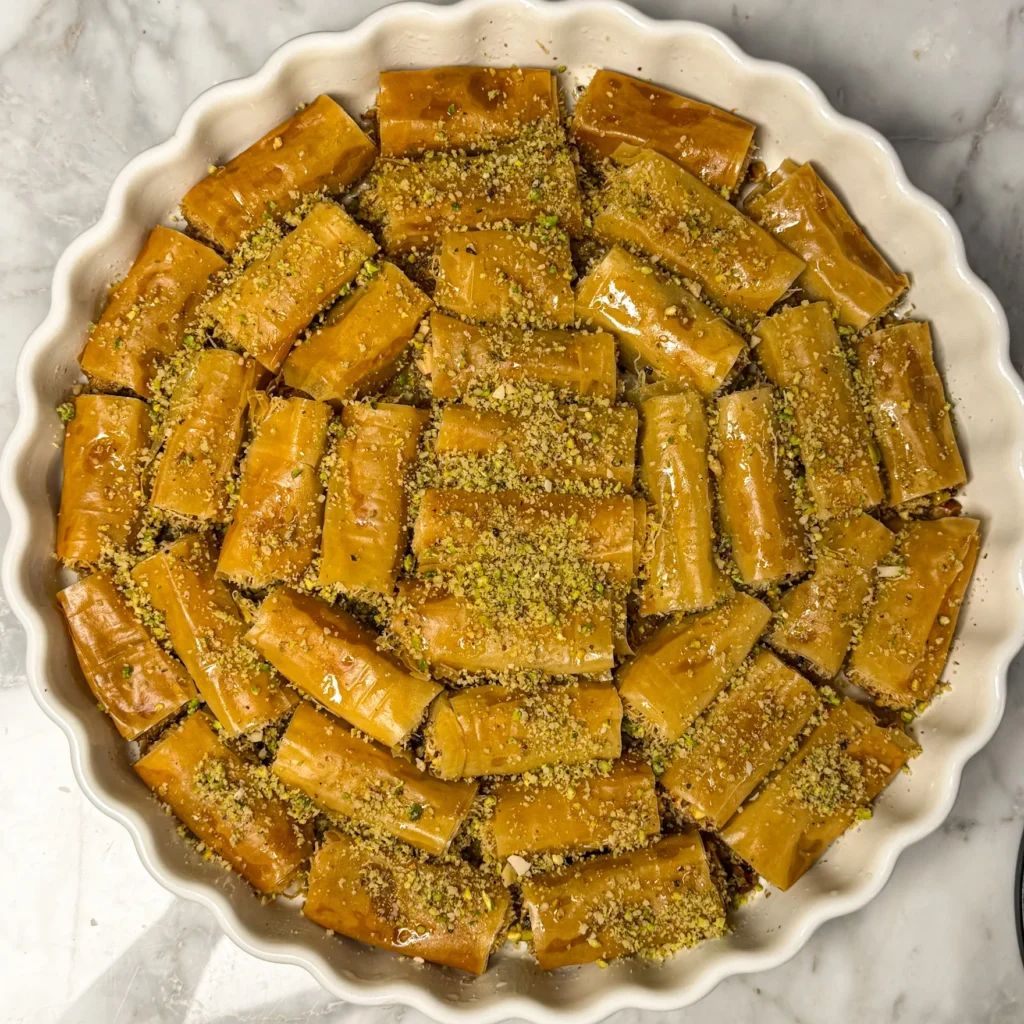
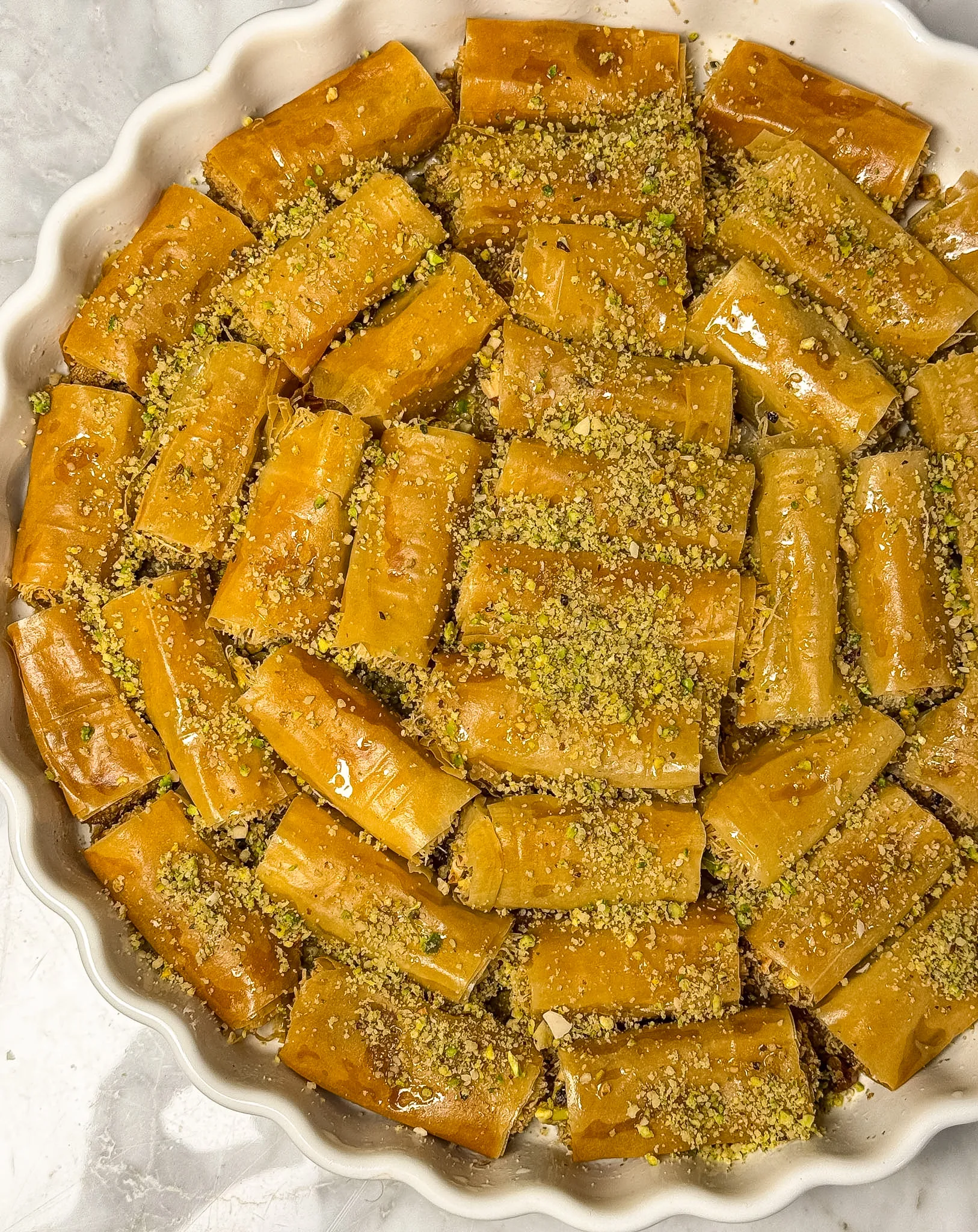
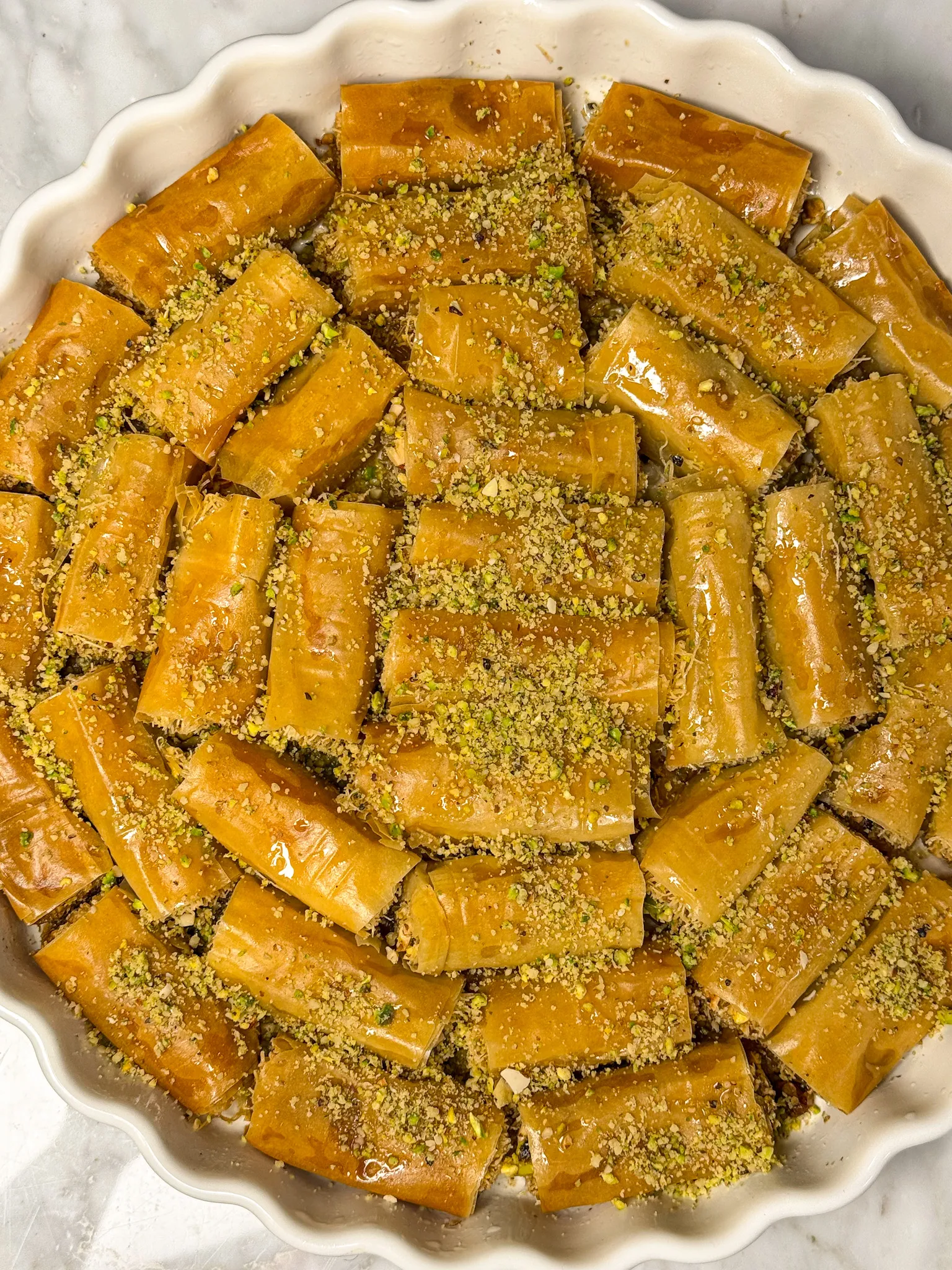
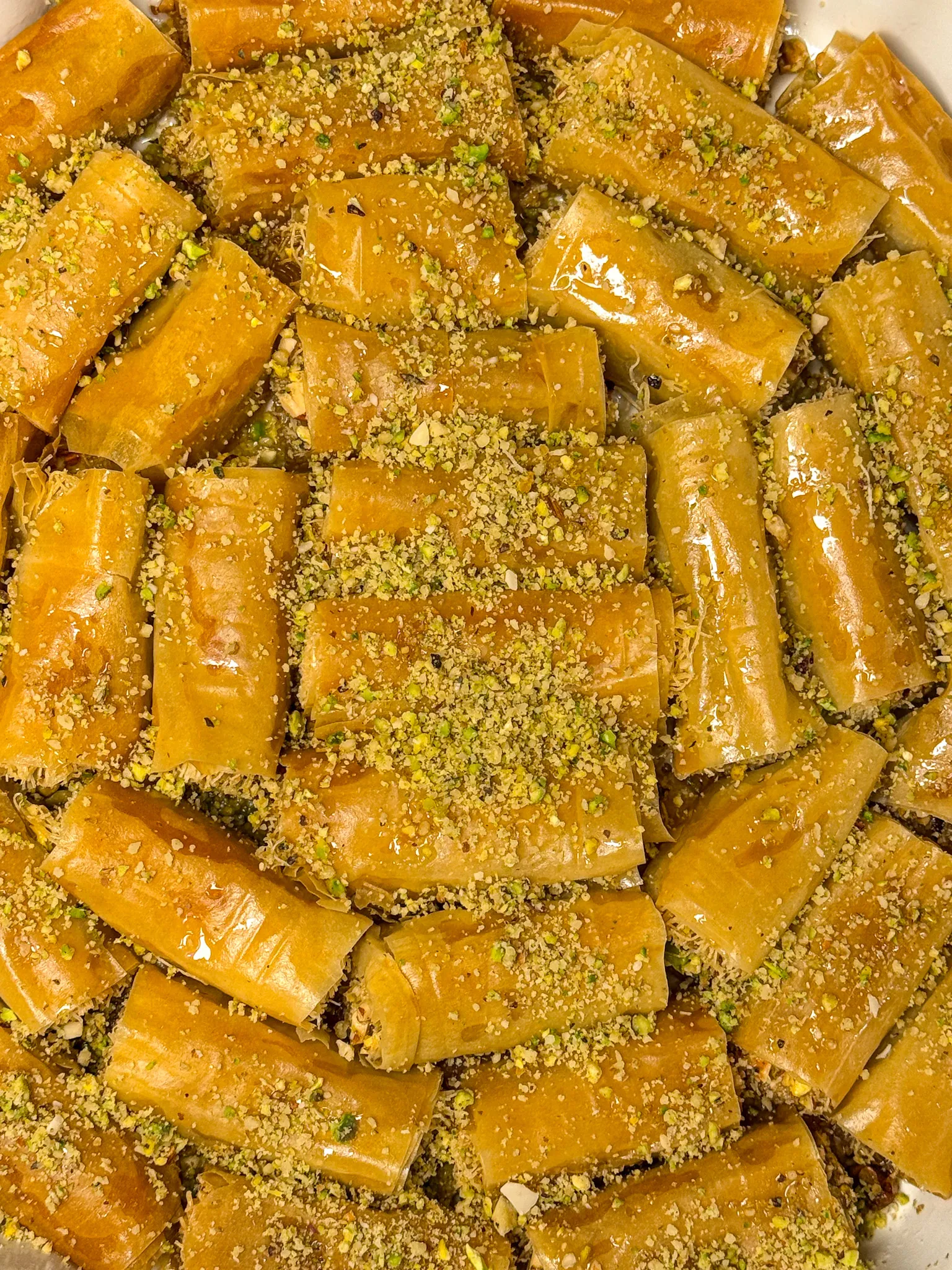
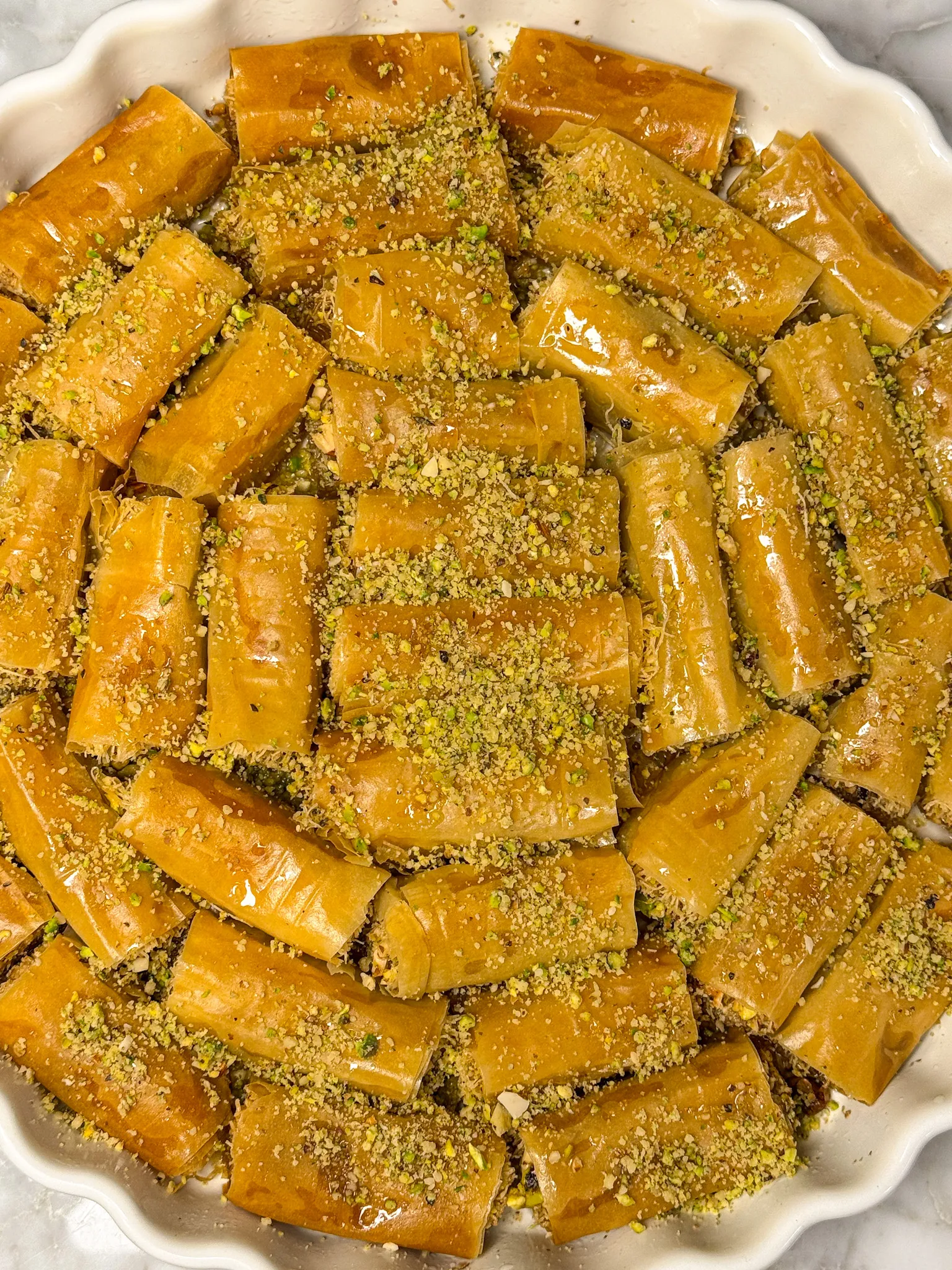
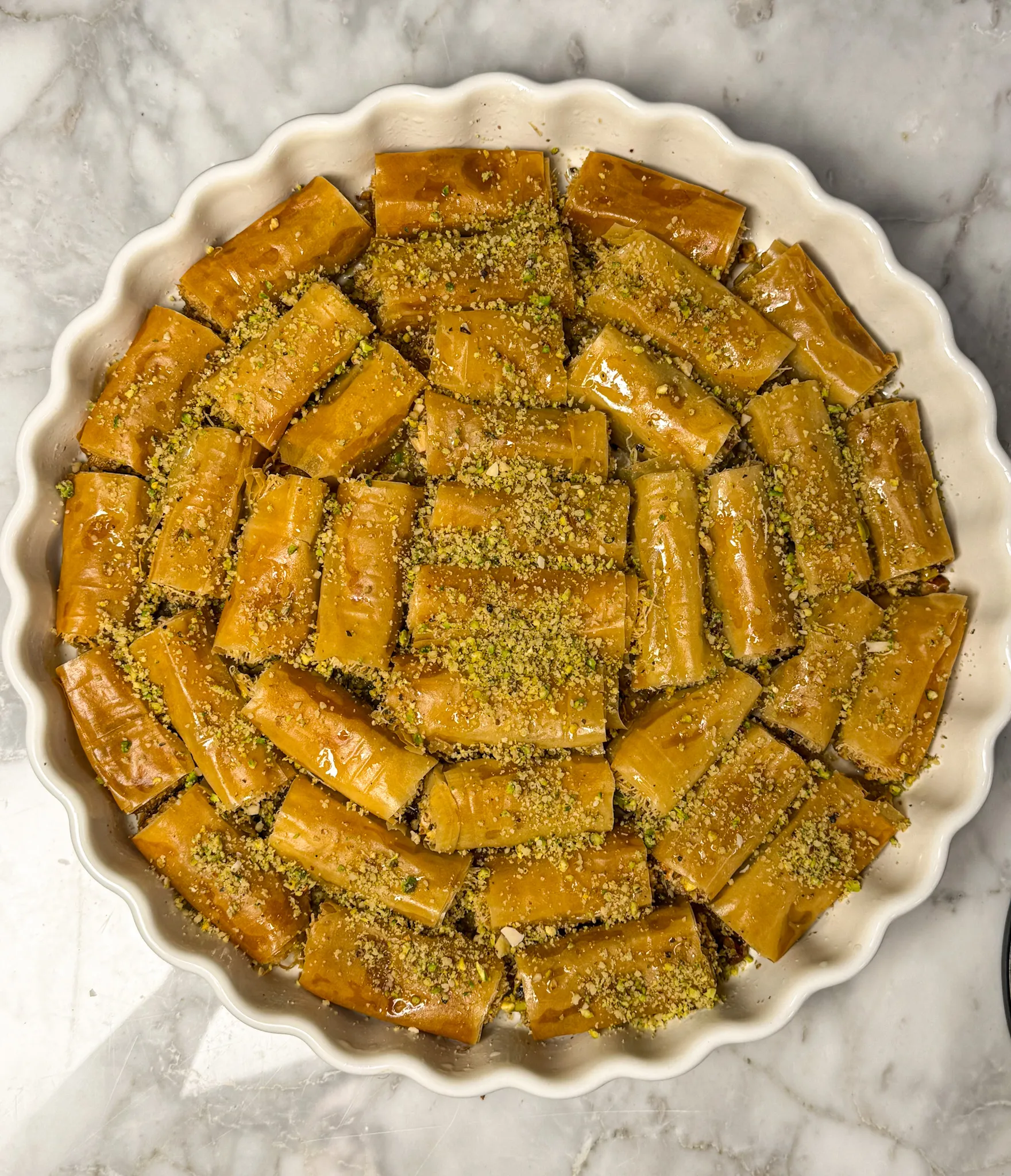
Bake the kunafa rolls recipe in the preheated oven for 28 to 35 minutes, watching closely from the 25-minute mark. The rolls should be a deep, even golden brown on top with no pale patches. If the tops are coloring faster than the sides, rotate the tray once during baking. Remove the tray from the oven and immediately pour the warm syrup slowly and evenly over all the rolls, ensuring every piece receives an equal amount. Allow the kunafa rolls recipe to rest at room temperature for a minimum of 2 hours before serving. During this time the syrup penetrates the layers fully and the rolls reach their best texture. Sprinkle crushed pistachios generously over the top before serving.
Professional Tips for Perfect Results
Keep the Phyllo Covered at Every Moment
The single most common cause of a failed kunafa rolls recipe is phyllo that has dried out during assembly. A dried sheet tears before it can be rolled, crumbles at the edges, and produces gaps in the crust that allow filling to spill out during baking. Keep a clean, lightly damp kitchen towel draped over the unused sheets from the moment the package is opened. Check the towel every few rolls and re-dampen if needed. Even 60 seconds of exposure to dry air can ruin a sheet.
Do Not Overfill
More filling feels more indulgent but actually works against this kunafa rolls recipe. An overfilled roll cannot be rolled tightly enough to stay sealed during baking, and the excess filling creates too much internal pressure as it heats, causing the phyllo to split and the rolls to unravel. Use a thin, neat line of kunafa filling and a moderate pinch of nuts for each roll. The restraint produces a cleaner, crispier kunafa rolls recipe where the pastry dominates and the filling accents.
Arrange the Rolls Snugly in the Tray
Packing the rolls close together in the baking tray before cutting keeps them in shape during baking and prevents them from toppling or spreading. Once they are cut into individual pieces, the snug arrangement also ensures even heat distribution through the whole batch. A kunafa rolls recipe baked in a crowded tray will have more even color and more consistent texture than one with rolls spaced widely apart, where the outer pieces brown much faster than the inner ones.
Pour the Syrup Immediately Without Hesitation
There is no benefit to waiting even one minute after the tray comes out of the oven before pouring the syrup in this kunafa rolls recipe. The window of maximum absorption is open for only a few minutes after baking, while the rolls are at their hottest and most porous. Pour the warm syrup in a steady stream across the entire tray, tilting the pan slightly to ensure even coverage. The sound of the syrup hitting the hot pastry — a brief, satisfying hiss — confirms the absorption is happening correctly.
The MANGO CREAM KUNAFA CUPS on this site offer a completely different but equally compelling take on kunafa pastry used in a modern format, and making both recipes for a gathering creates an impressive spread of contrasting flavors and textures from the same foundational ingredient.
Common Mistakes to Avoid
Using Dry, Clumped Kunafa Strands
Kunafa dough that has not been properly broken apart before use in this kunafa rolls recipe will bake into a dense, uneven filling. The clumped areas remain pale and slightly raw, while the outer surface of the clump crisps too quickly and becomes overdone. Always break the strands completely apart before mixing with ghee, and always check that every strand is individually coated before filling the rolls.
Skipping the Ghee on the Final Seal
Sealing the edge of the phyllo roll with ghee rather than water is one of the small details in this kunafa rolls recipe that makes a meaningful difference. Water works as an adhesive but does not contribute to the crisping or browning of that final edge. Ghee seals just as effectively and ensures the seam side of each roll browns as evenly as the rest of the surface, producing a uniformly golden kunafa rolls recipe with no pale or soft patches.
Pouring Cold Syrup on Hot Rolls
A syrup that has cooled completely to room temperature, or worse, has been refrigerated, will absorb far less effectively than a warm one. In a poorly timed kunafa rolls recipe, the cold syrup sits on the surface of the pastry rather than being drawn inward, and as it cools further it can crystallize slightly at the edges, producing a sticky, grainy exterior rather than the glossy, evenly sweet finish that defines a properly made kunafa rolls recipe.
Cutting the Rolls Before Baking
This kunafa rolls recipe calls for cutting the rolls into individual pieces after they have been arranged in the tray but before baking. Attempting to cut fully baked and syrup-soaked rolls will compress the layers and produce uneven, crumbling pieces that lose their shape. Cutting before baking ensures clean edges, allows the heat to reach every cut surface evenly, and makes the syrup absorption more thorough because the syrup can penetrate through the cut ends as well as the top.
Variations to Try
Pistachio-Only Kunafa Rolls Recipe
Replace the walnut and pistachio combination with an all-pistachio filling for a version of this kunafa rolls recipe that is more vibrant in color and more uniformly flavored. Pistachio-only kunafa rolls have a slightly more savory, nutty character and a vivid green interior that is visually striking when the rolls are cut. Add a tablespoon of pistachio paste to the kunafa filling mixture itself for an even more intensely flavored result.
Rose Water Syrup Variation
Add two tablespoons of rose water to the syrup of this kunafa rolls recipe after it has been removed from the heat and allowed to cool slightly. Rose water’s floral, delicately perfumed quality is one of the most traditional aromatics in Middle Eastern pastry and pairs beautifully with both the nuttiness of the filling and the buttery crispiness of the phyllo. For another Ramadan dessert that uses the same fragrant syrup tradition, MIDDLE EASTERN LOKMA BITES are an irresistible companion treat to serve alongside this kunafa rolls recipe at any festive gathering.
Chocolate Drizzle Kunafa Rolls Recipe
After the rolls have rested and the syrup has been fully absorbed, melt 80 grams of dark chocolate and drizzle it over the surface of the entire tray. Allow the chocolate to set at room temperature for 20 minutes before serving. The bitterness of the dark chocolate cuts through the sweetness of the syrup and adds a modern, indulgent dimension to the traditional kunafa rolls recipe. White chocolate also works beautifully and creates a visual contrast that makes the pistachio garnish stand out dramatically.
Orange Blossom Kunafa Rolls Recipe
Substitute the lemon juice in the syrup with the same quantity of fresh orange juice, then add two tablespoons of orange blossom water after the syrup is removed from the heat. This variation of the kunafa rolls recipe produces a syrup that is more fragrant and gently floral than the lemon version, with a slightly deeper golden color that comes from the orange juice. The orange blossom aroma is one of the most beloved in Middle Eastern dessert-making and gives this version of the kunafa rolls recipe an elegance that makes it particularly well-suited for serving at special occasions. The MIDDLE EASTERN CHURROS ( AKA BALAH EL SHAM ) are another excellent Ramadan and Eid dessert that pairs naturally with this kunafa rolls recipe as part of a larger sweet spread.
Storage and Reheating
Room Temperature
This kunafa rolls recipe, once rested and syrup-soaked, keeps beautifully at room temperature in an airtight container for up to 5 days. Unlike many pastries that begin to stale after 24 to 48 hours, the sugar in the syrup acts as a natural preservative, and the texture of this kunafa rolls recipe actually improves slightly on the second day as the syrup continues to distribute evenly through the layers. Store in a single layer or with parchment paper between layers to prevent the rolls from sticking together. Avoid refrigeration if possible, as cold temperatures firm the ghee and syrup and reduce the crispness and aroma of the rolls significantly.
Freezing
This kunafa rolls recipe freezes excellently, making it ideal for preparing in large batches ahead of celebrations. Allow the fully rested and syrup-soaked rolls to cool completely before placing them in a single layer on a baking sheet in the freezer. Once frozen solid, transfer to an airtight freezer bag with parchment paper between layers. The kunafa rolls recipe keeps at peak quality for up to 2 months frozen. Thaw at room temperature for 2 to 3 hours before serving. There is no need to reheat — the texture of the kunafa rolls recipe after thawing is excellent and requires no further treatment.
Reheating
If you prefer warm kunafa rolls, place the desired number of pieces on a baking sheet in an oven preheated to 160°C (320°F) for 5 to 7 minutes. This gently re-crisps the exterior of the rolls without driving off the syrup or over-browning the surface. A toaster oven works particularly well for small quantities. Avoid microwaving this kunafa rolls recipe, as the microwave heat is uneven and will make some layers of the pastry soft and rubbery while others remain untouched.
Frequently Asked Questions
What is kunafa rolls recipe made of?
This kunafa rolls recipe is made of three main components: a phyllo pastry outer shell, a kunafa (kataifi) dough and nut filling, and a sugar lemon syrup. The phyllo wraps around a mixture of ghee-coated kunafa strands and crushed nuts, forming a compact roll that is baked until golden and then soaked in syrup. The result is a dessert that is crispy, sweet, nutty, and fragrant all at once.
Can I make this kunafa rolls recipe ahead of time?
Yes, and it is one of the best-suited desserts for advance preparation. The rolls can be assembled and frozen unbaked for up to one month, then baked directly from frozen with an additional 8 to 10 minutes added to the baking time, and the syrup poured as soon as they come out of the oven. Alternatively, the fully baked and syrup-soaked kunafa rolls recipe can be made up to 3 days in advance and stored at room temperature — the flavor only improves with time.
Why is my kunafa rolls recipe not crispy?
The most common causes of soft kunafa rolls are insufficient ghee on the phyllo and filling, an oven temperature that is too low, or underbaking. Every sheet of phyllo used in this kunafa rolls recipe must be brushed generously with ghee — not merely wiped but genuinely coated. The oven should be fully preheated to 180°C before the tray goes in, and the rolls should remain in the oven until they are a deep, even gold with no pale patches. If in doubt, leave them in for an extra 3 to 4 minutes.
Can I use butter instead of ghee in this kunafa rolls recipe?
Unsalted butter is a workable substitute, but the flavor of the finished kunafa rolls recipe will be noticeably less rich and less complex. Butter also contains water that produces steam in the oven, which can slightly reduce the crispness of the phyllo compared to ghee. If ghee is unavailable, clarified butter — which has the milk solids and water removed — is the closest substitute and produces results much nearer to the original kunafa rolls recipe.
What nuts work best in this kunafa rolls recipe?
Pistachios and walnuts are the combination used in this kunafa rolls recipe, and they produce the most balanced and complex filling. Almonds can replace the walnuts for a milder, slightly sweeter filling. Cashews work well in a more modern version of the kunafa rolls recipe, providing a softer texture and a more neutral nutty flavor. Hazelnuts, though less traditional, add a deep, slightly chocolatey quality that pairs beautifully with a chocolate drizzle variation.
How do I prevent this kunafa rolls recipe from unraveling during baking?
Three techniques prevent unraveling in this kunafa rolls recipe. First, do not overfill. Second, roll each piece as tightly as possible, keeping the sides tucked in throughout the rolling process. Third, arrange the finished rolls snugly against each other in the baking tray before cutting. The pressure of the neighboring rolls holds each one in shape during the first few minutes of baking while the ghee heats and the pastry begins to set. Once the pastry starts to crisp, the shape is locked in and the rolls will hold together for the remainder of the bake.
Watch the recipe video for more clarity!
See our similar recipes:
People also like these recipes:
Final Thoughts
This kunafa rolls recipe is the kind of dessert that earns its reputation the moment it lands on the table. The combination of crispy phyllo, buttery kunafa strands, crunchy nuts, and fragrant syrup is not just delicious — it is deeply satisfying in a way that few desserts manage to be. Every element of this kunafa rolls recipe has a purpose, every technique has a reason, and once you understand both, the process becomes not just achievable but genuinely enjoyable.
What makes this kunafa rolls recipe worth returning to again and again is its versatility and its staying power. The rolls improve after resting, keep well for days at room temperature, and adapt effortlessly to different nuts, different syrups, and different garnishes depending on the occasion and the season. Make it pistachio-only for a Ramadan spread, add rose water to the syrup for an Eid gathering, or finish with a chocolate drizzle for a modern dessert table. This kunafa rolls recipe is a foundation as much as it is a finished dish.
Most importantly, this kunafa rolls recipe produces results that are unmistakably impressive, both in appearance and in flavor. The golden rolls, glistening with syrup and scattered with crushed pistachios, look like they came from the best pastry shop in the city. Knowing that you made them from scratch, with simple ingredients and straightforward techniques, makes them taste even better.
- Kunafa pastry strands
Powdered sugar
Melted ghee
Phyllo pastry sheets
Crushed nuts
Syrup
- 3 cups sugar
3 cups water
juice of half a lemon
Prepare syrup by boiling sugar, water, and lemon juice for 10 minutes.
Break apart kunafa strands and mix with powdered sugar and melted ghee.
Lay a sheet of phyllo pastry on the work surface.
Add kunafa filling and sprinkle nuts on top.
Roll tightly and brush the edge with ghee to seal.
Cut rolls into small pieces and place in a greased baking tray.
Brush the tops with melted ghee.
Bake at 180°C (350°F) until golden and crispy.
Pour syrup over the hot rolls and allow them to soak before serving.
If you've given this recipe a try and it won you over, please share your thoughts by leaving
a rating and comment below! If you have any questions about this recipe, don't hesitate to ask – I'm here to
help and will respond promptly.